
Synopsis
ADAS sensors play a vital role in preventing accidents, but even minor collisions can knock them out of alignment. Proper recalibration is essential for restoring accurate braking, steering assist, and driver alerts. Committed Collision & Auto Body Center explains why collisions affect ADAS, how calibration is performed, and why we partner with specialists so that your vehicle’s safety systems function correctly.
Key Takeaways
- Collisions can misalign ADAS sensors even when damage appears minor.
- Incorrect sensor data leads to delayed braking and unreliable warnings.
- Calibration is required by most manufacturers after any collision.
- Accurate calibration depends on proper structural repair first.
- Proper calibration protects safety, insurance compliance, and vehicle value.
Advanced Driver Assistance Systems play a major role in how modern vehicles prevent accidents and protect drivers. These systems rely on precise information from sensors, cameras, and radar units positioned throughout the vehicle. A collision, even at low speed, can disturb these components and disrupt how safety features respond on the road.
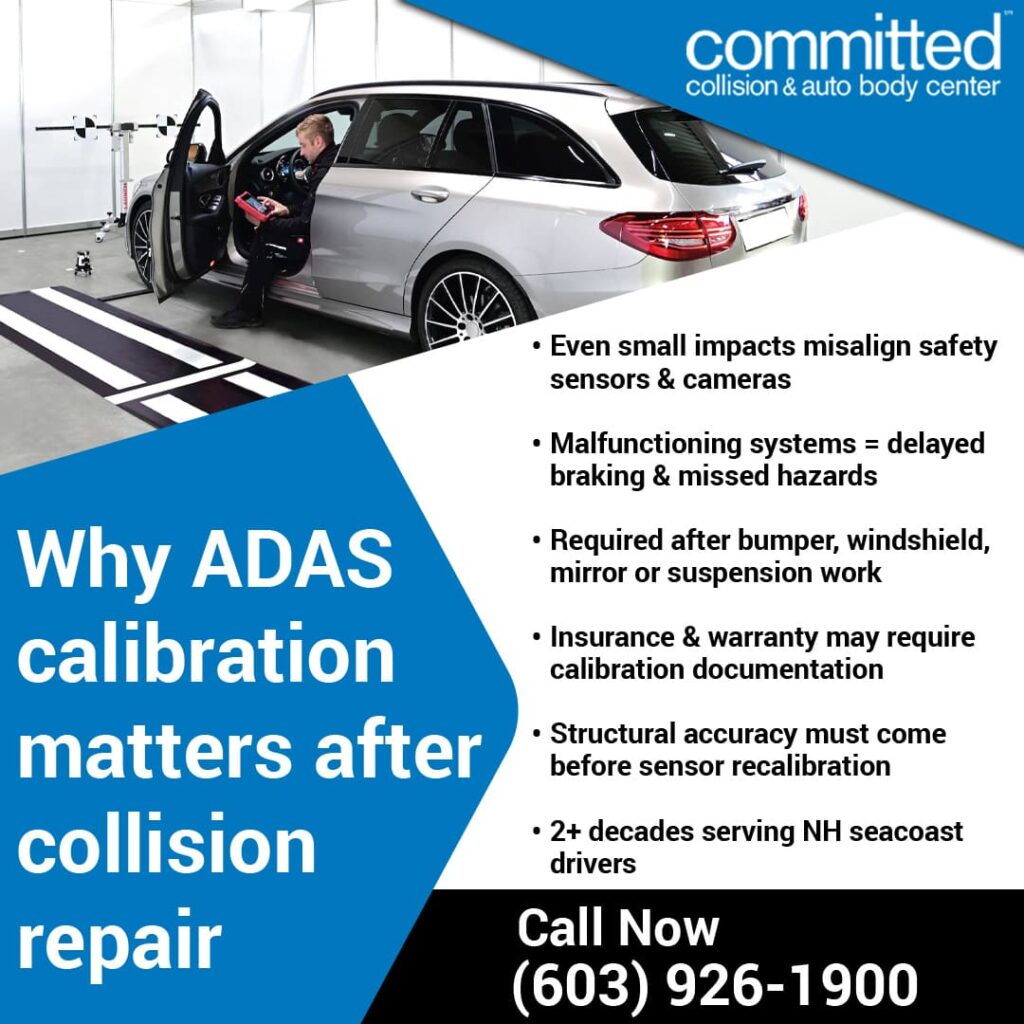
Committed Collision & Auto Body Center handles every part of your structural and auto collision repair with accuracy, and we coordinate all ADAS calibrations with our sister facility, Automotive Alignments & Calibrations LLC. This partnership restores your vehicle’s safety systems to manufacturer specifications. You will learn why collisions affect ADAS function, how calibration works, and why proper recalibration protects you, your passengers, and the value of your vehicle.
Understanding ADAS and Why It’s Critical for Modern Collision Repair
Advanced Driver Assistance Systems (ADAS) are designed to support safer driving and reduce the risk of accidents. Common ADAS features include lane departure warning, blind-spot monitoring, adaptive cruise control, automatic emergency braking, forward collision alerts, and rear cross-traffic detection. These features rely on a network of components placed with precise alignment at the factory.
Cameras, radar units, ultrasonic sensors, and LiDAR systems all work together to detect speed, distance, lane markings, surrounding vehicles, and potential hazards. When they function properly, these systems can significantly reduce collision risk. Research from the Insurance Institute for Highway Safety shows that automatic emergency braking reduces rear-end collisions by nearly fifty percent.
Even the smallest shift in sensor alignment can compromise these features. During auto collision repair, technicians often remove or reposition bumpers, windshields, mirrors, fenders, and grilles. All of these areas house ADAS sensors or affect their sightlines. Once repairs are complete, calibration becomes essential to restore the system’s accuracy. Without correct recalibration, the information your vehicle uses to make split-second decisions may be incomplete or incorrect. This connection between body repair and electronic safety systems is why calibration is an essential step in modern collision repair.
How Collisions Impact ADAS Sensors and Safety Systems
Collisions disrupt ADAS components in ways that are not always obvious. A bumper may look undamaged, yet the radar unit behind it may have shifted. A cracked windshield often requires replacement, which affects the camera that manages lane assist and traffic sign recognition. A dented fender can change the angle of a blind-spot sensor. Frame misalignment can change how sensors measure distance. Because ADAS components depend on precise positioning, even small structural changes create major safety concerns.
At Committed Collision & Auto Body Center, part of every collision repair includes structural measurement and diagnostic scanning. This allows our team to identify hidden damage that affects sensor placement. While we complete all repairs in-house, every ADAS calibration is performed by Automotive Alignments & Calibrations LLC. They use OEM-approved equipment for the correct alignment of both static and dynamic ADAS features.
| ADAS Component | Impact From Collision | Resulting Problem |
| Forward radar | Bumper hit or bracket movement | Incorrect distance readings |
| Windshield camera | Windshield crack or replacement | Lane assist malfunction |
| Blind-spot sensors | Damage to side panels or mirrors | False alerts or missed detections |
| Rear radar | Rear bumper impact | Park assist or cross-traffic detection errors |
These issues may not immediately trigger warning lights. A system may appear to function normally while relying on inaccurate data. That is why recalibration after a collision is required to ensure the vehicle responds correctly under real driving conditions.
Why ADAS Calibration Is Required After a Collision
Nearly every vehicle manufacturer requires ADAS calibration after a collision, windshield replacement, suspension repair, or an alignment change. This requirement exists because ADAS must function within tight tolerances to operate as intended. A radar sensor that is just a few degrees off may misjudge the distance to the vehicle ahead. A camera that sits too high or low may fail to detect lane markings. These small variations can cause delayed braking, missed warnings, or unexpected steering corrections.
Calibration restores the precision these systems rely on. At Committed Collision, we handle all collision-related repairs and structural restoration. Once that work is complete, we coordinate with Automotive Alignments & Calibrations LLC for ADAS calibration. They use OEM procedures and specialized equipment to align sensors exactly as the manufacturer requires.
We conduct pre- and post-repair scans to confirm that every required calibration is identified. This helps ensure the vehicle leaves our facility with fully operational safety systems and accurate documentation for insurance records. Skipping calibration is never recommended. It impacts safety, warranty coverage, and the overall integrity of the repair.
Behind the Scenes: How ADAS Calibration Works (Performed by AAC)
ADAS calibration is a precise process that requires controlled conditions, advanced equipment, and accurate structural alignment. While Committed Collision & Auto Body Center handles all structural and body collision repairs, our sister shop, Automotive Alignments & Calibrations LLC, performs the calibration required to restore ADAS performance. Here is how the process works from start to finish.
Step 1 – Pre-Repair Scanning at Committed Collision
Before we begin repairs, our car collision repair shop scans your vehicle to detect any ADAS-related fault codes or system malfunctions. This step gives us a clear picture of how the collision affected your vehicle’s sensors and modules. It also helps us determine which components will require recalibration later. Pre-repair scanning creates a baseline for comparison and supports accurate insurance documentation.
Step 2 – Structural and Mechanical Accuracy Before Calibration
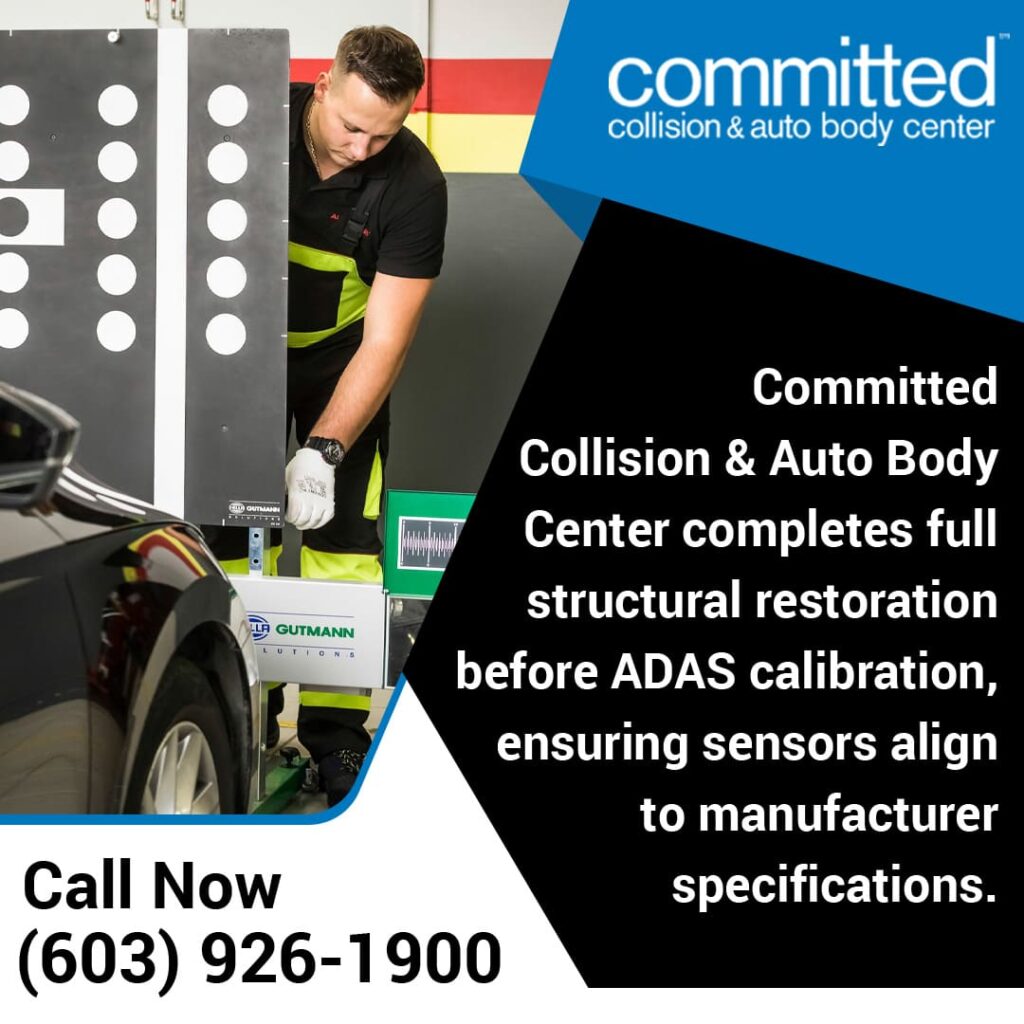
Calibration can only be performed once the vehicle’s structure is repaired and restored to factory measurements. Our collision repair specialists use Chief 3D Measuring Systems to verify the accuracy of the frame and unibody. Any misalignment in the structure makes calibration ineffective. After repairing body panels, realigning frame sections, and confirming the correct geometry, we prepare the vehicle for calibration. We hand over a properly restored vehicle ready for precise sensor alignment to AAC.
Step 3 – Calibration Performed by Automotive Alignments & Calibrations LLC
AAC uses OEM-approved equipment and the Hunter and Bosch DAS 3000 systems to perform both static and dynamic calibrations. Static calibration occurs inside the facility using targets and reference patterns that sensors must recognize. Dynamic calibration takes place on the road or in controlled conditions that allow sensors to learn correct measurements through real-time movement. Each manufacturer requires specific steps for calibration. AAC follows these guidelines carefully to align cameras, radar units, and sensors to exact OEM tolerances.
Step 4 – Verification and Reporting
Once calibration is complete, our calibration partner provides documentation showing that every system has been restored to manufacturer specifications. We review the results and complete a final inspection. We also clear any remaining fault codes and ensure there are no outstanding warnings. This verification provides confidence that your vehicle’s ADAS functions are fully operational before you return to the road.
Warning Signs That ADAS Systems Are Out of Calibration
Drivers often notice subtle changes in their vehicle’s behavior after a collision. These signs may indicate that sensors or cameras are out of alignment. Some of the most common symptoms include lane departure warnings activating too early or not at all, adaptive cruise control refusing to engage, blind-spot indicators flashing when no vehicle is present, or delayed automatic braking response. Steering assist may feel inconsistent, or the dash may display messages such as “camera blocked,” “sensor unavailable,” or “radar alignment required.”
Even if these symptoms are mild, they signal that the vehicle may not respond correctly in critical situations. Because ADAS systems rely on precise calibration, even small misalignments can create major safety risks. It is important to schedule calibration as soon as you notice these signs, especially after your vehicle has been involved in an accident.
What’s at Risk If ADAS Isn’t Calibrated After Collision Repair?
Ignoring ADAS calibration after a collision can lead to significant safety, financial, and legal consequences. Safety systems such as automatic emergency braking, lane assist, and blind-spot monitoring require exact alignment to function properly. A miscalibrated system may brake too late, warn you at the wrong time, or fail to detect surrounding vehicles. These errors increase accident risk.
There are also insurance considerations. Many insurers require documentation that calibration was completed after repairs. Without proper documentation, claims may be delayed or denied. Warranty coverage may also be affected. Manufacturers specify that calibration must occur any time a sensor is disturbed. Skipping this step can void warranty protections.
A realistic scenario illustrates the risk. Imagine a driver is involved in a minor parking lot collision. The front bumper appears only slightly dented. The radar sensor inside shifts a small amount. The driver delays calibration. During a winter commute, automatic braking activates too late because the radar misjudges distance. Although the driver avoided a major collision, the system did not operate correctly. Proper calibration could have prevented the issue entirely.
Calibration protects not only the driver but also the long-term health of the vehicle. It ensures accurate ADAS function and maintains the value and safety of late-model vehicles that rely heavily on advanced technology.
Why North Hampton Drivers Trust Committed Collision & Auto Body Center
Drivers across the New Hampshire seacoast rely on Committed Collision & Auto Body Center because of our experience, training, and dedication to precision. For more than twenty years, our family-owned business has provided high-quality auto collision repair that restores both structural integrity and appearance. Our team uses advanced tools, including Chief 3D Measuring Systems, to perform accurate repair work. Our technicians receive ongoing I-CAR Gold Class training to stay ahead of evolving modern vehicle designs.
We perform all structural, mechanical, and body collision repair work in-house. For ADAS calibrations, we rely on the expertise of Automotive Alignments & Calibrations LLC. Their facility has the specialized tools required for OEM-compliant calibration. Together, we deliver a complete repair process that addresses both visible and hidden issues. Our documentation, communication, and attention to detail help you handle the repair and insurance process with confidence.
Collision Repairs That Keep You Safe
If your vehicle has been involved in a collision, ADAS calibration is essential to restoring your safety systems. Accurate sensors help protect you, your family, and other drivers on the road. Committed Collision & Auto Body Center completes all collision repair steps and coordinates calibration with Automotive Alignments & Calibrations LLC so that every system operates as designed. To schedule an inspection, contact us at (603) 926-1900 or info@committedcollision.com to request an appointment. As one of the best collision repair shops in North Hampton, NH, we remain committed to quality, technology, and the repair you deserve.