
Synopsis:
Following OEM repair procedures after a collision protects your vehicle’s safety systems, structural integrity, and long-term performance. Committed Collision & Auto Body Center in North Hampton, NH, explains why manufacturer-specified repair methods matter for modern vehicles and how to verify your shop follows these standards.
Modern vehicles are engineered with precise safety systems and structural designs that require specific repair methods after a collision. When your car needs repairs, the question isn’t just about fixing visible damage. It’s about whether your shop follows the manufacturer’s exact instructions for restoring your vehicle’s safety and performance.
Committed Collision & Auto Body Center is a family-owned and operated auto body shop in North Hampton, NH. We have decades of combined auto body repair experience. We understand that OEM repair procedures represent more than industry guidelines. These manufacturer-published instructions determine whether your repaired vehicle will protect you as designed in a future accident.
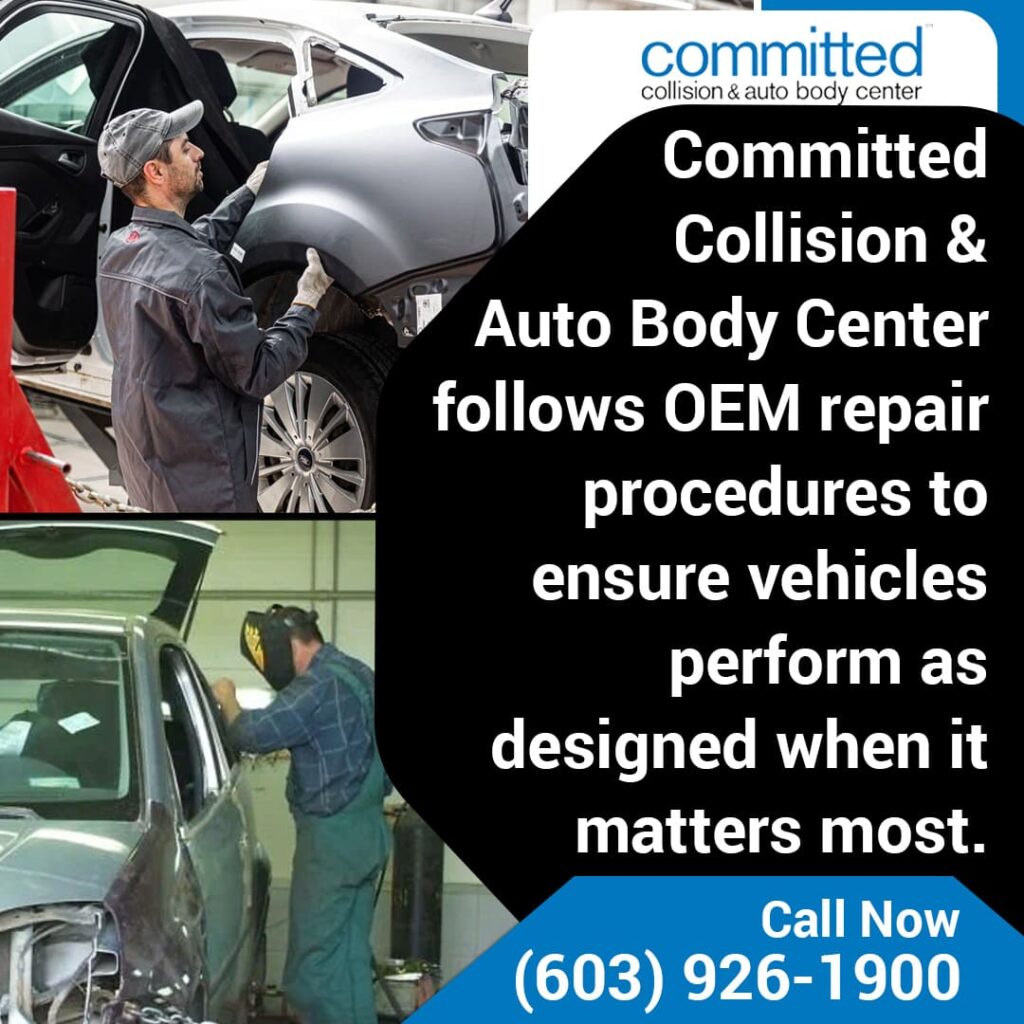
What OEM Repair Procedures Mean in Modern Auto Body Repair
OEM repair procedures are required, manufacturer-published engineering directives developed through crash testing, materials research, and structural analysis. These instructions guide how repairs must be executed to maintain crashworthiness and safety system performance.
Every vehicle manufacturer publishes detailed repair information specific to each make, model, and year. Different materials, such as aluminum on a 2024 Ford F-150 vs high-strength steel on other vehicles, require distinct joining methods, heat control protocols, and qualified tooling to ensure proper restoration. Professional auto body repair requires understanding these specific manufacturer requirements.
What OEM Repair Procedures Cover
Manufacturer repair information addresses specific technical requirements that any auto body repair shop should follow:
- Structural repair methods: Exact techniques for restoring frame rails, pillars, and load-bearing components
- Replacement versus repair decisions: When damaged parts must be replaced rather than straightened
- Welding, bonding, and sectioning locations: Precise locations where joints can be made
- Required scanning and calibration checkpoints: When diagnostic scans and system calibrations are needed
PARTS (Partnership for Analytics Research in Traffic Safety), a USDOT-NHTSA partnership with automakers, released findings in 2024. These showed that 10 of 14 key ADAS features passed 50% market share by the 2023 model year. The data covered nearly 98 million vehicles from nine manufacturers, spanning about 80% of the U.S. market. This percentage continues to grow as manufacturers add more advanced systems.
Why OEM Repair Procedures Directly Affect Vehicle Safety
Following manufacturer procedures isn’t about meeting arbitrary standards. It’s about restoring the crash protection technology your vehicle was designed with. When choosing an auto body repair shop in North Hampton, NH, understanding how they apply these procedures matters for your safety.
Structural Integrity and Crash Energy Management
Modern vehicles use controlled deformation to protect occupants during crashes. The structure channels impact energy away from passengers through specific load paths. When technicians ignore OEM structural repair procedures, they alter how your vehicle will perform in a future accident.
Improper welding locations can create hard spots that change how impact energy travels through the structure. Research from the Insurance Institute for Highway Safety indicates that improper structural repairs can significantly compromise crash protection compared to properly restored vehicles.
Airbags, Sensors, and Safety Timing
Airbag deployment depends on signals from crash sensors mounted throughout your vehicle’s structure. These sensors must be positioned exactly as designed to detect impacts and trigger airbags at the correct millisecond. When structural repairs change sensor mounting points or angles, your airbags might deploy too early, too late, or not at all.
Advanced Driver Assistance Systems and OEM Requirements
Systems like automatic emergency braking, lane departure warning, and adaptive cruise control rely on cameras and radar sensors positioned at specific locations and angles. According to the National Highway Traffic Safety Administration, automatic emergency braking systems have contributed to substantial reductions in rear-end collisions.
These systems require calibration following repairs to function correctly. A forward collision camera mounted just 2 degrees off-angle can misjudge distances by several feet at highway speeds. This is why local auto body repair specialists must have proper calibration capabilities.
What Can Go Wrong When OEM Repair Procedures Are Ignored
Auto body repair shops that don’t follow manufacturer procedures create risks that aren’t immediately visible when you pick up your vehicle.
Hidden Safety Risks After Collision Repairs
Your car might look perfect after repairs, but its cosmetic appearance doesn’t indicate proper structural restoration. Improper frame repairs can leave your vehicle with reduced crash protection. Incorrectly positioned sensors may fail to detect hazards. Uncalibrated systems might malfunction at highway speeds.
Insurance companies may deny future claims if inspectors discover previous non-compliant repairs, leaving you financially responsible.
| Consequences of Non-OEM Repairs | Impact | When You May Notice |
| Misaligned crash sensors | Airbag deployment errors | During a future collision |
| Improper structural welds | Reduced crash protection | Never visible until crash tested |
| Uncalibrated ADAS | System malfunctions or warnings | Within weeks to months |
| Wrong adhesive types | Panel separation, water leaks | 1-2 years post-repair |
| Skipped post-repair scan | Hidden fault codes | At the next service visit |
System Errors and Long-Term Value
Vehicles repaired without following OEM procedures often develop warning lights and fault codes weeks or months later. Sensor misalignment can cause unexpected braking interventions or lane-keeping assists that pull the vehicle incorrectly.
Improperly repaired vehicles lose value faster than those restored following manufacturer procedures. Future buyers increasingly request repair documentation. Vehicles without proof of OEM-compliant repairs sell for less or become difficult to trade in.
OEM Repair Procedures vs Insurance-Driven Repair Estimates
Understanding the difference between repair estimates and repair plans helps you recognize when corners might be cut during your auto body repair.
Insurance estimates serve as financial documents predicting repair costs. However, estimates are created before disassembly reveals all damage and don’t always reflect every OEM-required procedure.
Repair plans are technical documents based on manufacturer specifications. They outline the exact procedures technicians will perform, the sequence of operations, and the verification steps required. Shops providing professional auto body repair should update estimates when OEM procedures require additional work beyond initial assessment.
Clear communication throughout the repair process matters. You should receive updates when disassembly reveals additional damage or when OEM procedures require steps not included in initial estimates.
How to Tell If Your Auto Body Shop Follows OEM Procedures
You can evaluate whether a facility genuinely follows manufacturer procedures by asking specific questions before authorizing repairs. When seeking auto body repair in North Hampton, NH, verify that your chosen shop has both the capability and commitment to OEM standards.
Questions to Ask Before Authorizing Repairs
- Do you subscribe to OEM repair information for my vehicle’s make? Shops need manufacturer-published procedures to follow.
- What training do your technicians complete? Look for I-CAR Gold Class, ASE, and manufacturer-specific certifications.
- How do you handle required calibrations? Understand their process for ADAS calibrations.
- Will you provide written documentation of completed OEM procedures? Quality shops document their compliance.
These questions reveal whether the facility has the knowledge and resources to perform OEM-compliant work. Finding local auto body repair specialists who genuinely follow manufacturer procedures requires asking these specific questions rather than accepting general assurances.
Key Indicators of OEM-Compliant Shops
| Indicator | What to Look For |
| OEM Information Access | Active subscriptions to manufacturer repair systems |
| Technician Certifications | I-CAR Gold Class, ASE, brand-specific training |
| Equipment Capabilities | Laser measuring systems, diagnostic scanners |
| Repair Documentation | Written plans, photo documentation |
| Communication | Regular updates about the required procedures |
Understanding ADAS Calibration Within OEM-Compliant Repairs
Advanced Driver Assistance Systems require specialized calibration procedures that manufacturers specify as part of collision repair. ADAS calibration requires specific space dimensions, lighting conditions, and calibration targets.
Even minor repairs can misalign these sensors. Manufacturer guidelines specify when calibration is required and the exact procedures to follow. Windshield replacement on vehicles with forward-facing cameras requires recalibration to restore proper function.
Shops that coordinate with specialized facilities for ADAS calibration should include both static calibration (performed in controlled environments) and dynamic calibration (completed during test drives). We work with Automotive Alignments & Calibrations to handle required ADAS recalibration following collision repairs.
How OEM Procedures Are Applied in Practice
Proper collision repair centers maintain subscriptions to OEM repair procedure databases and reference these procedures during every phase of repair. When choosing an auto body shop in North Hampton, NH, understanding their equipment and process helps you make informed decisions.
Our Equipment for OEM Compliance
Shops following OEM procedures need specific equipment. At Committed Collision & Auto Body Center, we use:
- Chief 3D Laser Measuring System and Frame Machine: Verifies structural accuracy to factory specifications
- Spanesi Multibench pull stations with Spanesi Touch Measuring System: Provides precise frame straightening
- Pro Spot welding equipment (i4s spot welder, i5s spot welder, SP-5 Smart Mig, PR-5D): Handles different materials, including aluminum and high-strength steel
- Factory scan tools (Hyundai/Kia/GM/Ford/Toyota/Mazda/Nissan): Brand-specific diagnostic equipment identifies hidden damage
- USI Spray Booths: Maintain proper temperature and air quality for paint application
- Glasurit 100 Line waterborne paint system: Matches factory specifications used by over 80% of OEM manufacturers
Technician Training and Certifications
Technicians working on modern vehicles need ongoing education. Our team maintains I-CAR Gold Class certification, which requires continuous training to stay current with evolving repair procedures. We complete yearly training updates covering new vehicle technologies, materials, and repair techniques. Our technicians hold ASE certifications and attend manufacturer-specific training programs.
A Typical OEM-Compliant Auto Body Repair Process
A proper repair process includes several key steps:
- Pre-washing, Scanning, and Disassembly: Technicians clean the vehicle to reveal all damage, use OEM-approved OBD-II scanners to read diagnostic codes, and disassemble body panels to look for hidden damage.
- Complete Damage Assessment: Technicians map out all damage, including structural issues that aren’t visible from the outside. We pre-measure the auto body to assess structural integrity.
- OEM-Based Planning: Repair plans are created based on manufacturer specifications. We create a detailed repair plan that includes an itemized list of repair procedures, parts needed, an estimated timeline, and an initial cost estimate.
- Part Sourcing: OEM parts are prioritized for proper fit and performance. We source premium OEM parts to guarantee fit and performance that meets factory standards.
- Structural Repair: Frame and structural work follow factory specifications. Our skilled technicians perform structural repair of the chassis and frame according to factory specifications, including aluminum repair services.
- Painting and Refinishing: Surface preparation, priming, paint application with Glasurit waterborne paint, and clear coating follow manufacturer guidelines.
- Reassembly: Components are reassembled following the manufacturer’s torque specifications and assembly sequences.
- Calibration Coordination: Required ADAS calibrations are scheduled and completed through our coordination with Automotive Alignments & Calibrations.
- Post-Repair Quality Control: We perform complete visual inspection, function testing, diagnostic testing with OBD-II scanners, and road testing to verify repairs meet standards.
We photograph each repair stage and provide updates when additional required procedures are discovered.
What to Expect From Your Repair Facility
When choosing where to have your vehicle repaired, consider these factors:
- Access to OEM Information: The facility should demonstrate that they have current subscriptions to manufacturer repair databases for your vehicle’s make.
- Qualified Technicians: Look for shops with I-CAR Gold Class certification and technicians with ongoing training.
- Appropriate Equipment: The facility should have frame measuring systems, diagnostic scanners, and proper welding equipment for different materials.
- Clear Communication: You should receive updates about discovered damage and required procedures throughout the repair.
- Documentation: Request written repair plans and photo documentation showing work performed.
- Calibration Capabilities: Understand how the facility handles ADAS calibration requirements, whether in-house or through coordination with specialized facilities.
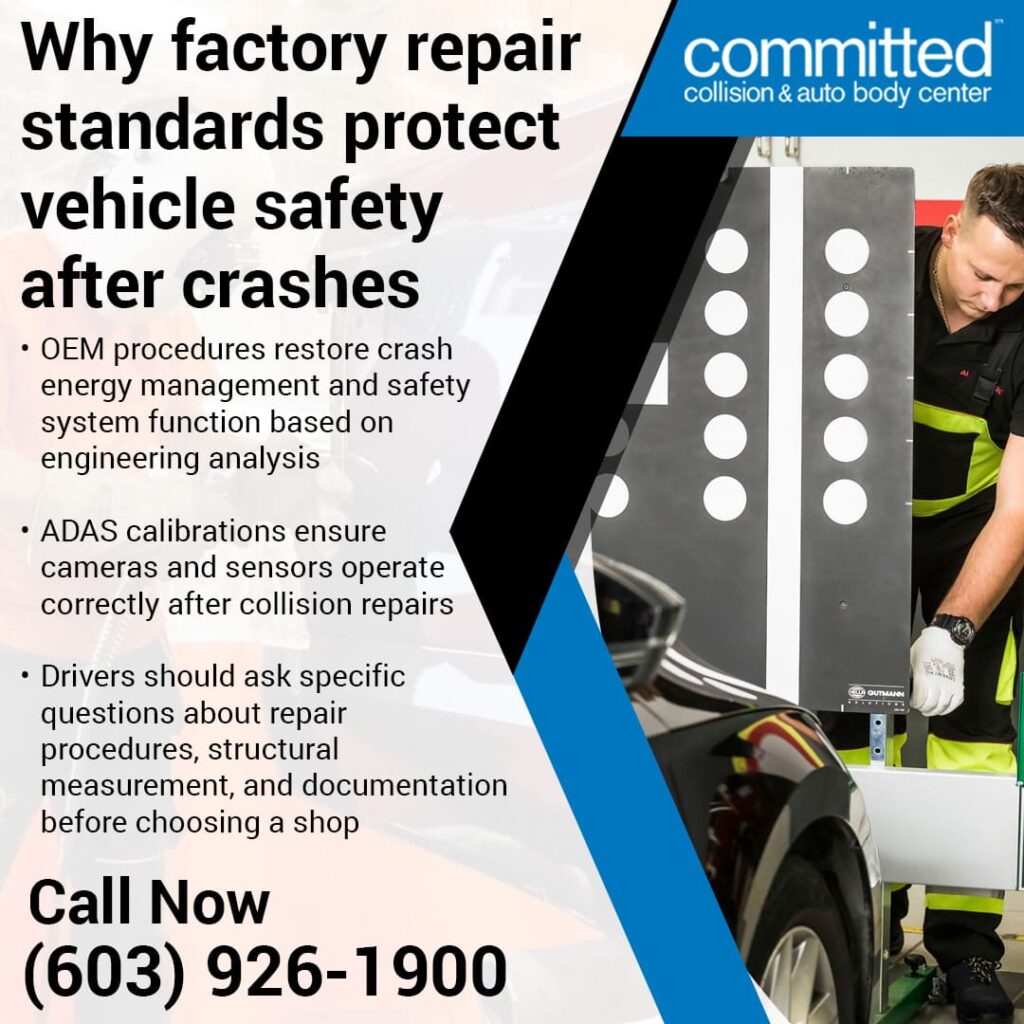
Get OEM-Compliant Auto Body Repair in North Hampton, NH
OEM repair procedures protect the crash protection technology and structural integrity that manufacturers engineered into your vehicle. These procedures are the specific instructions required to restore your car’s safety features and system performance.
Ask informed questions before authorizing repairs. You have the right to understand how your vehicle will be restored and whether the shop follows manufacturer procedures. Choose your repair facility based on its process, transparency, and commitment to manufacturer standards.
Your safety and your vehicle’s long-term reliability depend on proper repairs that follow OEM specifications from the start.
Do you have questions about OEM repair procedures for your vehicle? Contact Committed Collision & Auto Body Center at (603) 926-1900 or email us at info@committedcollision.com. We are your go-to auto body repair shop in North Hampton, NH, that helps you with all of your auto body, collision, and mechanical repair needs.