
Synopsis
Modern plastic bumpers are more complex than they appear. Committed Collision & Auto Body Center outlines how bumper damage is properly assessed, what a correct repair process involves, and why the shop you choose directly affects your vehicle’s safety and long-term value.
Your bumper is the first component to absorb force in a collision. Most late-model vehicles use plastic bumper covers rather than steel because plastic dissipates impact energy, reduces weight, and houses the sensors that driver assistance systems depend on.
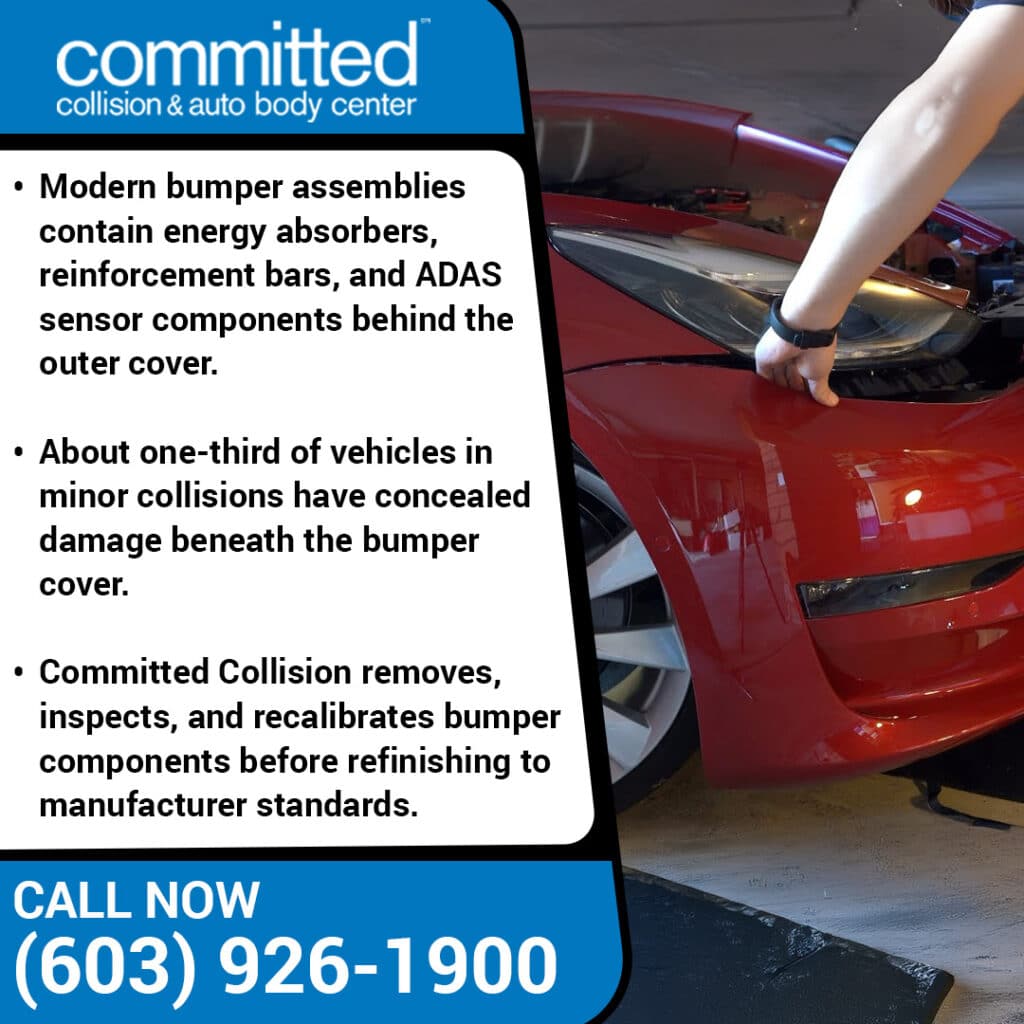
Plastic cracks and deforms differently from metal, and it conceals damage. Behind every cover are brackets, foam absorbers, reinforcement bars, radar modules, and parking sensors that a surface check cannot reach. At Committed Collision & Auto Body Center, our process for auto body repair in North Hampton, NH, starts by looking past the surface. What is hidden behind the cover often matters more than what you can see.
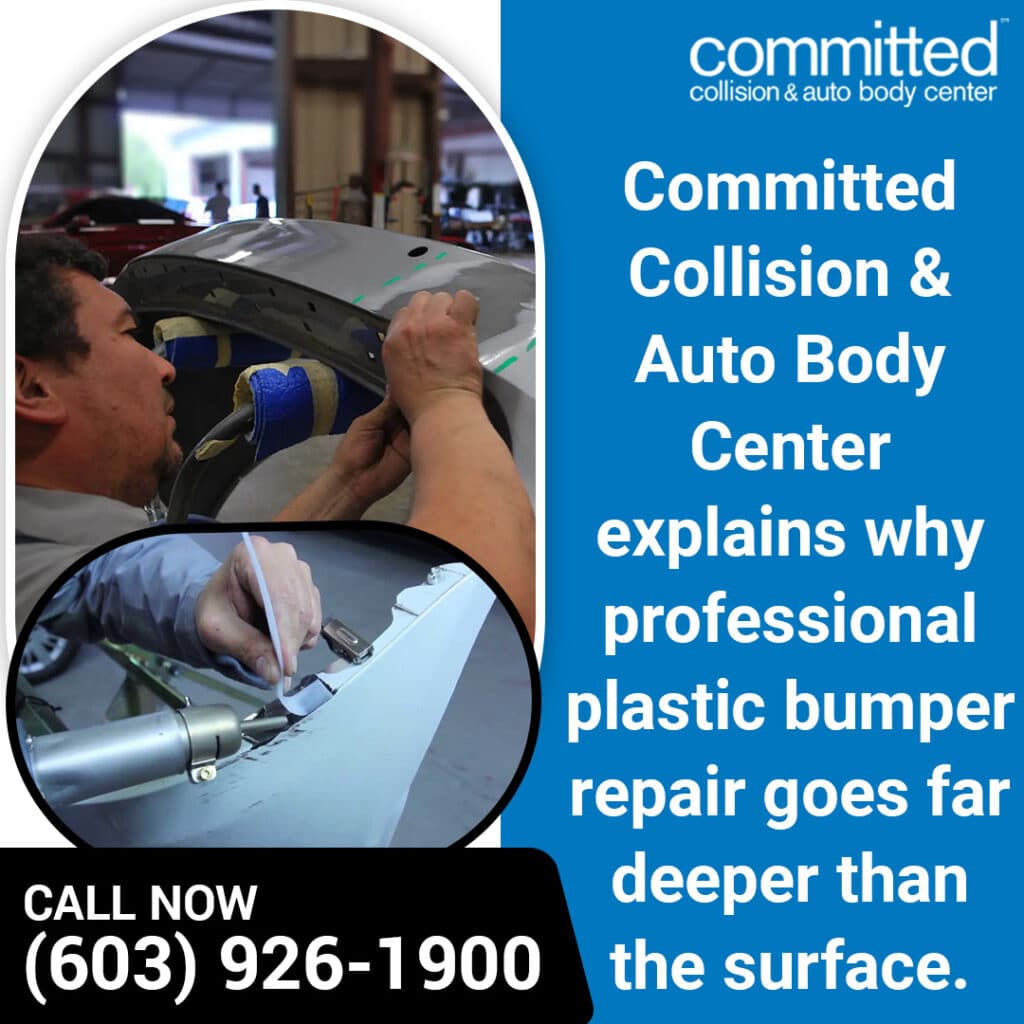
Materials Used in Modern Bumper Covers
Most late-model bumper covers are made from one of three flexible compounds:
- Polypropylene (PP): Lightweight and impact-resistant. Standard on most economy and mid-range vehicles.
- Thermoplastic Olefin (TPO): A rubber-polypropylene blend. Common on trucks and SUVs.
- Polycarbonate blends: Found on some luxury models; harder, but more prone to cracking on direct impact.
Each material requires specific primers, fillers, and welding techniques. Using the wrong product causes adhesion failure as the cover flexes through seasonal temperature changes.
How Common Is Bumper Damage?
A report by NHTSA states that rear-end collisions account for approximately 29% of all light-vehicle crashes, around 1.8 million police-reported incidents per year.
A survey of 509 vehicles processed at insurance drive-in claims centers found that one in three cars involved in minor front or rear collisions sustained hidden bumper damage, meaning the bumper had made contact with the vehicle frame or adjacent components beneath the cover, even though the outer surface looked undamaged.
| Collision Type | Most Affected Area | Damage Commonly Found |
| Parking lot contact | Front or rear bumper cover | Scratches, scuffs, paint transfer |
| Low-speed rear-end | Rear bumper cover and fascia | Cracks, sensor bracket displacement |
| Intersection fender bender | Front bumper and grille | Structural deformation, bracket damage |
| Curb or barrier contact | Lower bumper fascia | Paint scrapes, foam absorber compression |
What Hides Behind the Bumper Cover
A surface crack or scuff can mask more serious damage:
- Sensor mounting brackets shifted out of position
- Compressed or split foam energy absorber
- A bent reinforcement bar that no longer absorbs impact correctly
- Pinched wiring harnesses connected to safety system sensors
We remove the cover whenever there is any sign of more than cosmetic damage. What we find underneath determines the repair plan and whether your vehicle is safe once repairs are complete.
How We Assess Bumper Damage
Visual inspection comes first, checking for cracks, panel gaps, deformation, and paint transfer. At our auto body shop in North Hampton, NH, all damage is photographed for the repair plan and insurance records.
Disassembly follows when the impact pattern suggests hidden damage. We inspect the reinforcement bar, foam absorber, sensor brackets, wiring harnesses, and fascia support. A cover can appear intact while the components behind it have shifted.
Diagnostic scanning completes the picture. We use an OBD-II scanner to check for fault codes after any bumper impact, identifying disrupted safety sensors even when the surface looks undamaged.
Repair or Replace: How We Decide
The decision depends on damage type and structural condition, not appearance alone.
Damage typically suited for professional auto body repair:
- Surface scratches or paint scuffs with no structural deformation
- Minor dents under approximately one inch deep
- Small cracks that haven’t split fully through the cover material
Damage that calls for replacement:
- Severe cracking, large punctures, or missing cover sections
- Broken mounting tabs that cannot be structurally restored
- Sensor housing or bracket deformation
- A bumper previously repaired in the same location was damaged again
| Surface scratch or paint scuff only | Repair |
| Small crack, cover intact | Repair with plastic welding |
| Broken mounting tabs | Replacement |
| Sensor housing displaced | Replacement and recalibration |
| Prior repair, same damaged area | Replacement |
We review our findings with you and provide a free, no-obligation estimate before a single repair is approved.
The Professional Auto Body Repair Process for Plastic Bumpers
Step 1 Cleaning:
We remove all road film, wax, and contaminants before anything else. Residue left on the panel interferes with adhesion at every stage.
Step 2 Plastic Welding or Flexible Filler:
Cracks require plastic welding. Heat fuses the material from behind, reinforcing the repair from the inside. For dents without cracking, we use flexible body filler made for plastic substrates. Standard metal-panel filler is too rigid and will fracture as the bumper flexes. For minor shallow dents with intact paint, our Keco PDR and Glue Pull Station restores the panel without disturbing the original finish.
Step 3 Sanding:
We sand through progressively finer grits to restore the bumper’s original contour. Any surface irregularity at this stage will show in the finished paint.
Step 4 Primer:
A plastic-compatible bonding primer improves adhesion, creates a consistent base, and reveals remaining imperfections before color is applied.
Step 5 Color Matching and Paint:
Color is achieved through computerized analysis of the factory paint code, adjusted for how the original paint has aged. We apply Glasurit 100 Line waterborne paint in controlled passes inside our USI Spray Booths.
Step 6 Clear Coat and Curing:
Clear coat restores gloss, blocks UV damage, and hardens the finish. A controlled bake cycle inside the spray booth produces a more durable result than air-drying.
Step 7 Reassembly and Detail:
We reinstall the cover with all sensors, brackets, trim, and hardware. A final quality check confirms alignment and paint consistency. Every repair is finished with a full interior and exterior detail.
Paint Matching on Plastic vs. Metal
Metal panels are rigid and reflect light consistently. Plastic bumper covers flex slightly, so the same paint formula can read differently depending on the angle or lighting, even when the color code matches exactly. This is a material characteristic, not a refinishing error. To minimize visible variation, our technicians use computerized color-matching, adjust the formula for the vehicle’s paint age, and blend into adjacent panels as needed. Our team uses Glasurit 100 Line waterborne paint, the same system trusted by over 80% of OEM manufacturers worldwide.
Safety Systems Inside Modern Bumpers
Modern bumper assemblies house components that support critical safety features: parking sensors for front and rear proximity detection, radar modules for adaptive cruise control and forward collision warning, camera housings for backup and surround-view systems, and blind-spot sensors embedded in the rear fascia. When these components shift during an impact, their detection zones change. Many manufacturers require ADAS recalibration after any bumper-involved collision. We work closely with Automotive Alignments & Calibrations LLC to complete the recalibrations your vehicle requires, using OEM-compliant methods and Hunter/Bosch DAS 3000 equipment.
Why Choose Our Auto Body Repair Shop in North Hampton, NH
Our technicians hold I-CAR Gold Class and ASE certifications and complete yearly training on the latest vehicle models and repair methods. We follow OEM procedures on every job, work with all major insurance carriers, and back all workmanship, paint, and parts with a limited lifetime warranty.
As a trusted auto body repair shop serving the New Hampshire seacoast for over 20 years, we handle every repair, from minor bumper scuffs to complex collision damage, with the same standard of care.
New Hampshire Winter and Bumper Damage
Icy pavement and reduced visibility from November through March increase low-speed bumper contact across the seacoast region. Road salt accelerates deterioration at any unrepaired crack or paint chip, exposing the plastic substrate and surrounding hardware to corrosion throughout the season. Proper refinishing rebuilds that protective barrier and stops the damage from spreading.
Frequently Asked Questions
Can a cracked plastic bumper be repaired?
In many cases, yes. Cracks can be addressed through plastic welding and refinishing. Severe cracking, large holes, or sensor mounting damage may require replacement. The answer depends on what inspection reveals once the cover is removed.
How long does bumper repair take?
Timelines depend on damage extent, parts availability, and insurance approvals. Minor cosmetic work may be done in one to two days. Repairs involving disassembly, parts ordering, or recalibration take longer. We provide a timeline once our repair plan is complete.
Will the repaired bumper match my vehicle’s paint?
We use computerized color-matching and Glasurit 100 Line waterborne paint for the closest possible match. Some variation between plastic and metal panels is normal due to how each material holds paint. We blend into surrounding panels when needed.
Do modern bumpers contain safety sensors?
Yes. Most late-model vehicles have radar modules, parking sensors, cameras, and collision warning components behind the bumper cover. These require inspection and often recalibration after any bumper-involved collision.
Trusted Auto Body Repair in North Hampton, NH for Modern Vehicle Bumpers
A damaged bumper is not just a cosmetic concern. Proper plastic bumper repair requires the right materials, trained technicians, and a process that accounts for everything behind the cover.
Contact Committed Collision & Auto Body Center at (603) 926-1900, email info@committedcollision.com. With the expertise of our trusted local auto body repair specialists, you get the quality and the repairs you deserve.