
Synopsis:
Paint matching errors during auto body repair often result from poor preparation, incorrect color assumptions, and a lack of blending. Committed Collision & Auto Body Center explains common mistakes and how our auto body shop in North Hampton, NH, restores factory-level finishes that protect your vehicle’s value, appearance, and long-term durability.
Paint matching goes wrong when shops rely on paint codes alone, skip surface preparation, or fail to account for how materials and lighting affect color. The result is a repair that looks patched; something buyers, appraisers, and observant drivers notice right away.
After a collision, color accuracy is part of a complete auto body repair, not an afterthought. It affects appearance, long-term paint durability, and your vehicle’s resale value. Our team at Committed Collision & Auto Body Center has handled paint and finish restoration on the NH Seacoast for over 20 years. Here is what goes wrong at shops that cut corners, and how we approach every refinishing job differently.
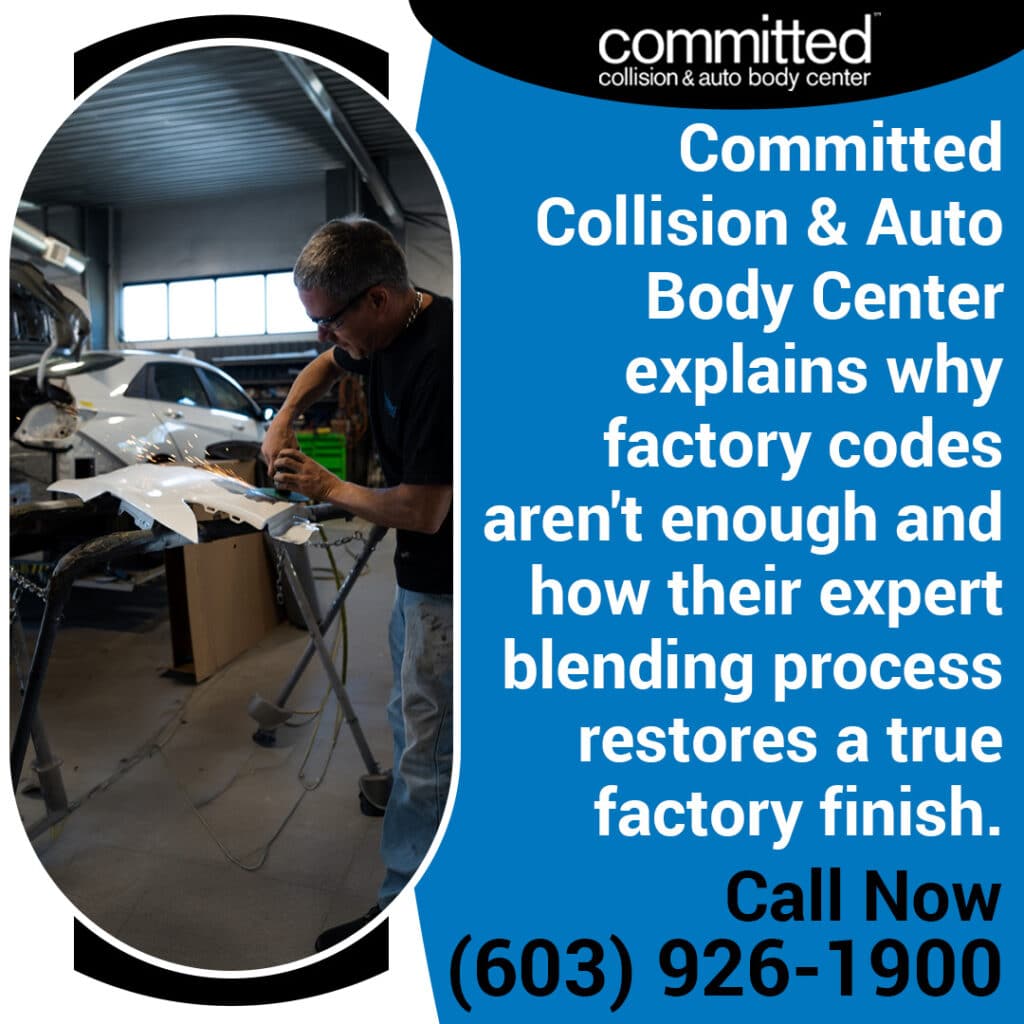
Why Accurate Paint Matching Matters After a Collision
Paint matching means blending a repaired or replaced panel back to the original factory finish, not just the damaged area. A poor match shows under direct sunlight, during a trade-in inspection, or when a buyer compares panels side by side.
The financial consequences are real. According to Carfax, the average impact on the retail price of a used car is about $500 following an accident, and that figure jumps to $2,100 for vehicles with severe damage. Kelley Blue Book confirms that accident history lowers resale value even after professional repairs. Beyond the accident itself, automotive appraisers recognize repair-related diminished value: when repairs fail to restore a vehicle to pre-accident condition, including visible paint problems, the financial loss compounds beyond what the accident itself caused.
Proper refinishing from a qualified auto body repair shop prevents this outcome.
| Factor | What Poor Paint Matching Costs You |
| Resale value | Additional loss from repair-related diminished value on top of the accident history |
| Visual result | Color differences between panels are most visible in outdoor daylight |
| Buyer confidence | Signals incomplete or substandard repair work |
| Paint protection | Inadequate refinishing exposes metal to rust and moisture damage |
Beyond resale, paint has a functional role. A correctly applied multi-layer finish seals metal panels against salt, moisture, and UV exposure, all active concerns along the NH Seacoast year-round.
Common Paint Matching Mistakes Made at Inexperienced Shops
Treating the Paint Code as the Final Answer
A factory paint code is where color matching begins, not where it ends. Paint fades and shifts over years of UV exposure, seasonal changes, and washing. A technician who applies the code formula without accounting for how the existing finish has aged will produce a panel that looks visibly newer than everything around it.
Overlooking Environmental Wear
UV rays gradually alter a paint’s undertone. Salt air and humidity accelerate surface oxidation. A shop that mixes paint to the original code without evaluating the vehicle’s actual condition will produce a result that looks acceptable in the shop, and increasingly mismatched outdoors as both finishes age at different rates.
Skipping or Rushing Surface Preparation
New paint bonds to what is beneath it. If a panel is not properly sanded, cleaned, and primed, adhesion will be poor. The finish may look acceptable at pickup, then peel, bubble, or crack within months. Rushed prep is one of the most consistent causes of refinishing work failing early.
Leaving Hard Paint Edges
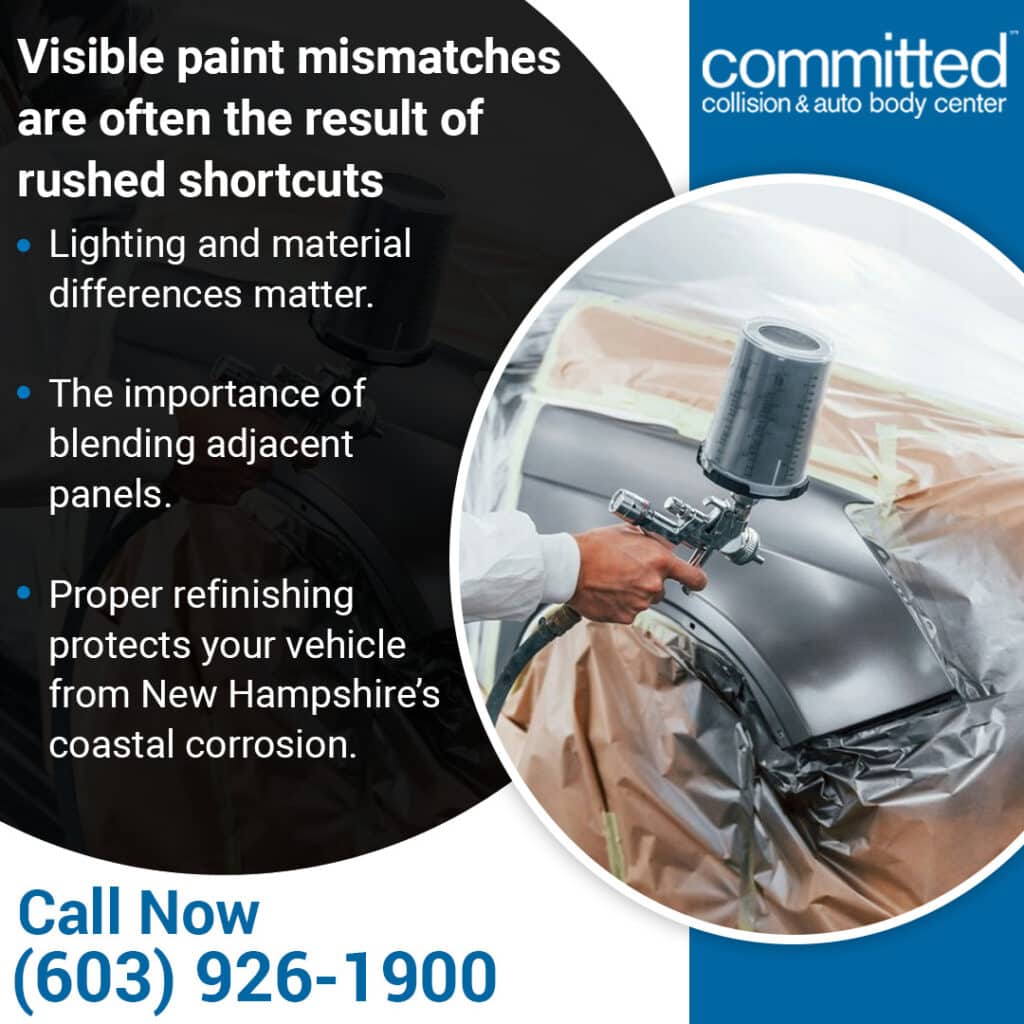
Applying new paint only to a damaged panel, without blending into adjacent ones, leaves a visible line where the two finishes meet. On larger panels like doors, fenders, and quarter panels, this edge is obvious in raking light or direct sun. Blending new paint into surrounding panels is what makes a repair invisible rather than visible.
Using Materials That Do Not Meet Factory Standards
Lower-grade paint products fade faster and respond to light differently than the waterborne systems that today’s vehicle manufacturers apply at the factory level. Under shop lighting, the difference may seem minor, but outside, under changing conditions, it becomes clear. Inferior clear coats also offer less UV protection, meaning any mismatch worsens over time rather than stabilizing.
Why Paint Matching Is More Complex Than It Looks
Late-model vehicles use multi-stage paint systems: a base coat for color, a mid-layer for metallic or pearl effects, and a clear coat for protection and gloss. Each layer must be applied in the correct sequence, at the right thickness, under controlled conditions.
Plastic bumper covers and metal panels hold color differently. Even factory-applied paint can look slightly different between a bumper cover and a steel fender because each material absorbs and reflects color at different rates. A technician must evaluate each surface separately and adjust accordingly, not apply a single formula across all panels.
Lighting compounds this. Color that looks matched under shop fluorescents can appear off in the afternoon sun. Checking results under multiple lighting conditions before a vehicle leaves the shop is not a finishing touch; it is how you confirm the work is actually correct.
How Our Auto Body Shop in North Hampton, NH Gets Paint Matching Right
Computerized Paint-Matching System
We use a computerized paint-matching system that reads your vehicle’s original manufacturer paint code and generates a starting formula specific to your make, model, and finish type. Our technicians then evaluate the vehicle’s actual current condition, how much the existing paint has faded, what type of finish is involved, and how adjacent panels are reading, before applying any color.
Technician-Led Color Adjustment
The system gives us a foundation. Our technicians refine it. They adjust pigment ratios based on direct evaluation of the vehicle, accounting for age-related fading, finish type, and the difference between metal and plastic panel surfaces. This hands-on step is what moves a result from close to correct.
Full Panel Blending
We blend paint into panels adjacent to the repair so no visible edge is created between old and new finish. This applies to every job that requires it. The standard we hold to is a repair that is undetectable in full daylight, not just under shop conditions.
Glasurit 100 Line Waterborne Paint
We use Glasurit 100 Line waterborne paint; the same paint system used by over 80% of OEM manufacturers worldwide. It is not an approximation of factory quality. It is the standard that vehicle manufacturers use at the production level, which is why color consistency and long-term durability hold up under real-world conditions.
Climate-Controlled Spray Booths and Bake Cycle
Paint application and curing take place in our USI Spray Booths, a controlled environment that eliminates airborne contamination and holds temperature and humidity at consistent levels. After the final coat, the repair goes through a temperature-calibrated bake cycle. Dust, humidity spikes, and temperature shifts all affect how paint settles and bonds. Controlled conditions are a requirement for a finish that holds up, not a convenience.
OEM Parts Where Panel Fit Affects Color
A replacement panel that does not fit correctly will read differently from surrounding panels, regardless of how well the color is matched. Committed Collision & Auto Body Center prioritizes OEM parts, so replaced panels meet the same tolerances as the originals. Fit and finish work together; one cannot compensate for a failure in the other.
Our Refinishing Process at a Glance
Professional auto body repair follows a defined sequence. Here is how paint and finish restoration works at our shop:
- Assessment and disassembly: We begin with a visual inspection, then disassemble affected areas after authorization. This reveals hidden damage not visible during the initial walkthrough. A full repair plan is written using OEM procedures before refinishing begins.
- Surface preparation and primer: Affected areas are sanded to the correct profile, fully cleaned, and primed. Primer creates a uniform base and protects bare metal from corrosion, both critical before any color is applied.
- Color matching and multi-layer application: We run the paint code, adjust the formula based on the vehicle’s actual condition, and apply the base coat in thin, controlled passes. Clear coat follows in layers, then the repair is cured in our spray booth at a calibrated temperature.
- Polishing, inspection, and detailing: After curing, we polish the surface and inspect finished panels against adjacent panels under multiple lighting conditions. Every vehicle leaves with a full interior and exterior detail before delivery.
Signs a Paint Match Was Not Done Correctly
Before accepting your vehicle from any auto body repair shop, check it in natural daylight. Look for:
- A visible color difference between the repaired panel and the adjacent ones
- A hard edge where new paint meets original finish
- One panel is noticeably shinier or flatter than the surrounding panels
- A bumper cover that reads distinctly different from the hood or fender outdoors
- Uneven texture between panels
A correctly completed refinishing job should be indistinguishable from the original finish at arm’s length in full daylight.
How Proper Refinishing Protects Your Vehicle’s Value and What to Know About Insurance
A correctly matched paint repair protects more than appearance. It maintains the finish that shields steel panels from corrosion and protects your resale position. Poor repairs create repair-related diminished value beyond what the accident itself caused. Working with local auto body repair specialists who follow a complete, documented refinishing process is one of the most direct ways to protect what your vehicle is worth.
Paint blending is sometimes a friction point with insurance adjusters. Our position is that blending is part of a complete repair. We work with all major insurance providers, communicate directly with adjusters on your behalf, and document every procedure we perform. If a carrier questions a paint-related charge, we contact you promptly and help work through the process with full documentation. The priority at our auto body shop in North Hampton, NH, is that your vehicle is restored correctly.
Committed Collision & Auto Body Center backs every paint repair with a limited lifetime warranty on workmanship and paint for as long as you own the vehicle.
Frequently Asked Questions
Can paint ever match perfectly?
A professional repair should be undetectable in normal viewing conditions. Some variation between plastic and metal surfaces is expected even from the factory, because each material holds color differently, and color can shift slightly across different angles and lighting. What matters is that the result holds up consistently, which is what full blending and a multi-lighting inspection deliver.
Why does a bumper sometimes look different after a repair?
Plastic bumper covers and metal panels absorb and reflect color at different rates. Even identical paint applied to both can appear slightly different depending on the light or angle. Our technicians adjust the approach for each surface type and blend carefully at the edges to minimize this difference, returning your vehicle to an acceptable post-repair condition that meets both appearance and safety standards.
Call Our Auto Body Shop in North Hampton, NH for a Free Estimate
Paint matching requires the right materials, a defined process, and technicians who evaluate every variable at each stage. Shops that cut steps on prep, blending, or materials produce results that show up later in daylight, at trade-in, and on the repair itself.
At Committed Collision & Auto Body Center, professional auto body repair means following every step from disassembly through final detailing. We use Glasurit 100 Line waterborne paint, used by over 80% of all OEM manufacturers, USI Spray Booths, and a computerized matching system backed by hands-on technician refinement. Every repair carries a limited lifetime warranty on workmanship, paint, and part performance for as long as you own the vehicle.
If your vehicle needs auto body repair in North Hampton, NH, after a collision, call us at (603) 926-1900, email info@committedcollision.com, or request a free estimate online.