
Our auto collision repair team at Committed Collision & Auto Body Center addresses this question often: Is your vehicle worth repairing, or is it a total loss?
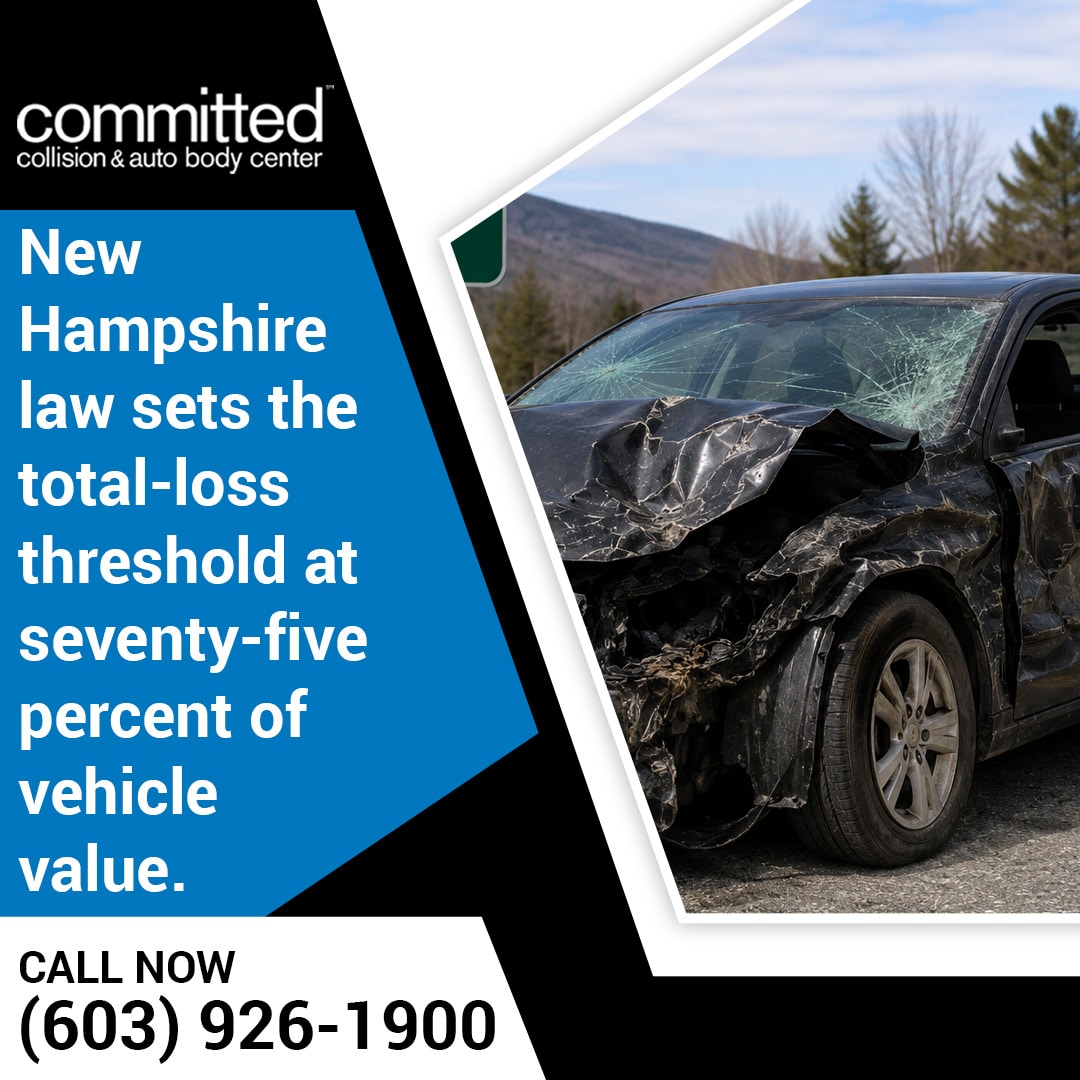
A vehicle is a total loss when repair costs reach a set share of its pre-accident value. Under New Hampshire RSA 261:22, a vehicle is generally considered a total loss when repair costs reach 75% or more of its fair market value before the damage, if the damage occurs during the model year or the next four calendar years.
Key Takeaways:
- 75% threshold: New Hampshire law sets repair cost at 75% or more of actual cash value as the total-loss line for vehicles within five model years (RSA 261:22).
- Older vehicles use a different test: Beyond the five-year window, the statute does not set out the same 75% total-loss threshold.
- Documentation supports a fair outcome: We photograph and itemize every estimate at Committed Collision & Auto Body Center, repaired or totaled.
How Do Insurers Decide If a Car Is a Total Loss?
Insurers compare the projected repair cost against the vehicle’s pre-accident fair market value. Once the repair cost reaches a set share of that value, most states, including New Hampshire, treat the vehicle as a total loss instead of authorizing repairs. As a car collision repair shop, we see insurers apply this comparison to nearly every claim that comes through our doors.
What Does New Hampshire Law Say About Total-Loss Thresholds?
New Hampshire sets the 75% repair-cost threshold for vehicles within their model year or the four following years, under RSA 261:22. For those vehicles, once the repair cost reaches 75% or more of fair market value, state law treats them as a total loss. Older vehicles fall under a broader standard instead: “physically or economically impractical to repair,” with no fixed percentage. The statute excludes inflatable restraints, tires, and entertainment systems.
Repair costs can shift once a shop opens the vehicle up. Hidden damage found during teardown can push an estimate past that 75% line. At Committed Collision & Auto Body Center, we document visible and hidden damage on every collision repair before finalizing the repair cost.
An estimate built only from visible damage can undercount a car near the threshold. Full teardown documentation separates an accurate number from a rushed one.
How Does Actual Cash Value Compare to Repair Cost?
Actual cash value (ACV) is a vehicle’s worth before a collision, based on age, mileage, and condition. Repair cost is the projected expense of body collision repair, including parts, labor, and paint.
| Factor | Actual Cash Value (ACV) | Repair Cost |
| What it measures | Vehicle’s pre-accident worth | Cost to restore the vehicle |
| What affects it | Age, mileage, condition, comparable sales | Parts, labor, hidden teardown damage |
| Who calculates it | Insurer, using market data | Repair shop or appraiser, using an itemized estimate |
What Should You Do If Your Vehicle Is Repairable?
Once a vehicle is confirmed repairable, request an itemized estimate, ask about supplemental damage, and keep every document tied to the assessment. A collision repair specialist should be able to explain each line item before work begins.
- Request an itemized estimate: Ask for a line-item breakdown of parts, labor, and paint costs.
- Ask about supplemental damage: Confirm whether teardown might reveal more damage, since findings affect cost and timeline.
- Keep your documentation: Save photos, the estimate, and insurer communication in case the cost changes.
At Committed Collision & Auto Body Center, we provide this same itemized documentation on every claim, repair, or total loss, which is part of why local drivers consider us the best collision repair shop in North Hampton, NH.
Frequently Asked Questions
Can I keep my car after it’s declared a total loss in New Hampshire?
In many cases, yes. The insurer can release the vehicle to you, though you’ll receive a salvage title and it must be inspected before reregistration.
Does a total loss work differently for a leased vehicle?
Yes. The payout usually goes to the leasing company, since it holds the title, before any balance reaches you.
Can you dispute an insurer’s total-loss valuation?
Yes. Under N.H. Admin. Code Ins 1002.15, the insurer must give you a written, itemized valuation. You can submit comparable listings or an independent appraisal if the offered value seems low.
Get an Itemized Auto Collision Repair Estimate
Whether your vehicle ends up repaired or totaled, an accurate estimate protects you. Contact us at (603) 926-1900 or info@committedcollision.com for auto collision repair in North Hampton, NH, that restores your vehicle to the highest industry standard.