
Synopsis
Vehicle owners often wonder if neglected scratches and dents can still be fixed. Most aging damage remains repairable when addressed by qualified technicians using proper methods. Committed Collision & Auto Body Center helps North Hampton drivers understand how time and New Hampshire’s climate affect body damage, and when professional intervention protects both safety and vehicle value.
You may have a small scratch from the grocery store parking lot from three years ago. A door ding may have appeared last winter. You keep meaning to get them fixed, but life gets busy. Is it even worth repairing at this point?
The reality might surprise you. Most aging body damage can still be corrected with appropriate techniques. However, the longer you wait, the more complex repairs become. Exposed metal oxidizes. Paint deteriorates. What started as a simple cosmetic issue can evolve into structural concerns requiring extensive work.
Committed Collision & Auto Body Center has been providing top-notch auto body repair in North Hampton, NH, for two decades. Our technicians regularly evaluate vehicles with damage that owners have postponed addressing. We have encouraging news for you. Even years-old scratches and dents usually respond to professional treatment. Knowing how damage progresses helps you decide when to take action before minor problems escalate into expensive repairs.
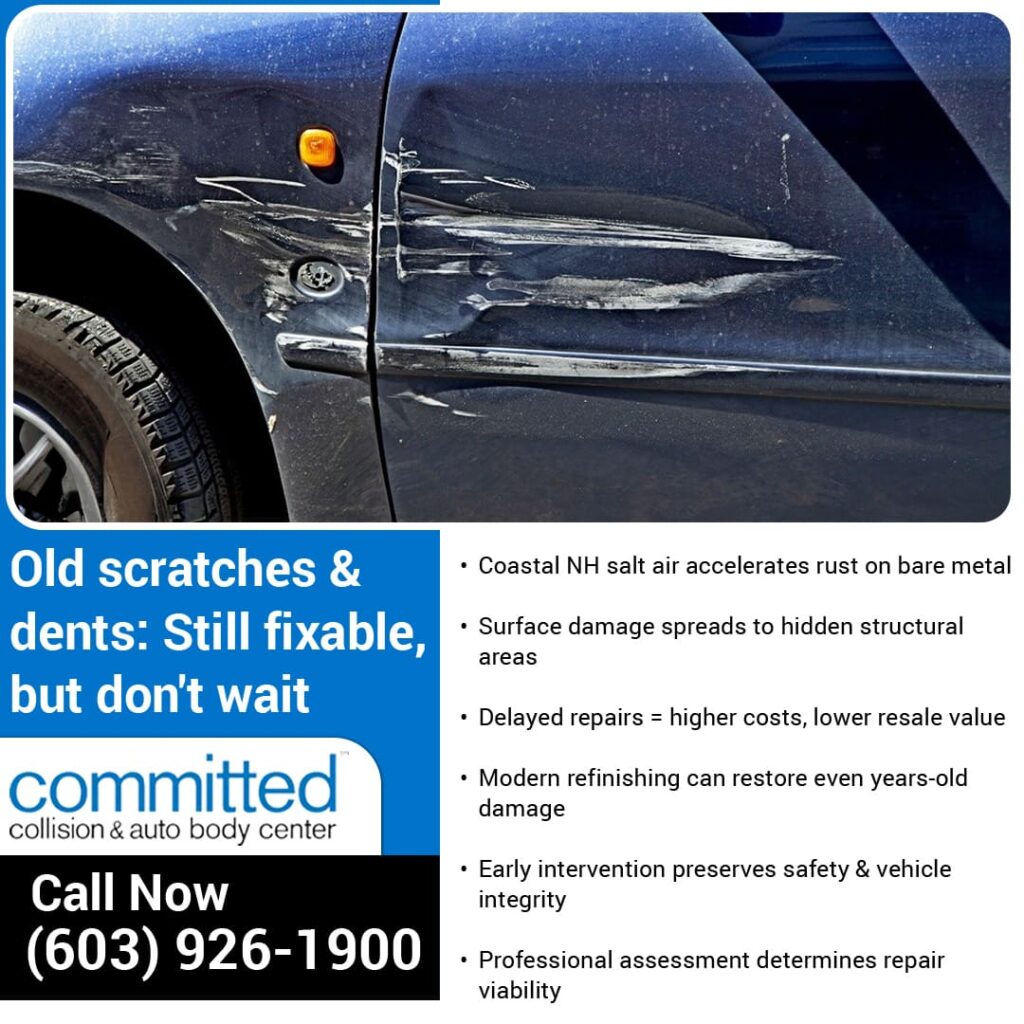
How Time Changes Minor Scratches and Dents
Body damage behaves differently depending on its depth and location. Shallow marks affecting only the clear protective coating may remain relatively stable. Deeper gouges penetrating through paint layers to bare metal start corroding almost immediately. Impact damage creates creases, forming weak points where panels continue to degrade.
Multiple factors influence the deterioration speed. Ultraviolet radiation breaks down paint chemistry. Moisture combines with oxygen to form rust. Temperature fluctuations stress damaged areas. Road chemicals accelerate all these processes.
New Hampshire presents particularly harsh conditions. Winter road treatments contain highly corrosive compounds. According to the Federal Highway Administration, road deicing chemicals contribute billions of dollars annually in corrosion-related vehicle and infrastructure costs nationwide, with vehicle corrosion representing a significant portion of these losses. Living near the Atlantic coast adds constant salt exposure even during warmer months.
How Body Damage Evolves Over Time
| Timeframe | Surface Scratches | Metal-Deep Scratches | Impact Dents |
| First 3 months | Limited change | Oxidation begins | Paint stress cracks |
| 3–12 months | UV breakdown starts | Rust spreads beneath finish | Moisture intrusion |
| 1–3 years | Visible paint fading | Panel corrosion | Interior rust formation |
| Beyond 3 years | Coating failure | Structural compromise | Replacement often needed |
Freezing temperatures create additional complications. Water expands when it turns to ice. Trapped moisture beneath compromised paint expands nightly during cold weather, progressively lifting more coating away. In harsh winter environments like New Hampshire, small paint chips can expand significantly over multiple seasons as freeze-thaw cycles and road salts accelerate coating failure.
Warning Signs That Damage Needs Immediate Attention
Specific indicators reveal when cosmetic issues have progressed into serious concerns. Recognizing these signals prevents minor repairs from becoming major restoration projects.
Visual Red Flags:
- Oxidation spreading beyond the original damage boundaries
- Blistering paint indicating subsurface rust formation
- Bare metal visible through completely failed coatings
- Peeling or flaking finishes around affected zones
- Brown-red staining migrating from stone chips
Performance Issues:
- Whistling sounds at speed from misaligned panels
- Uneven gaps or warped surfaces near wheels
- Doors requiring extra force to latch properly
- Moisture entering the cabin or trunk areas
- Dashboard alerts from disrupted sensor systems
These symptoms matter beyond appearance. Load-bearing components like rocker panels and roof pillars provide collision protection. Latch mounting areas must align correctly for restraint systems to function. When corrosion weakens these regions, it reduces occupant safety during accidents.
Our evaluation includes pre-washing to expose all affected areas, OEM-approved diagnostic scanning to check vehicle computer systems, and complete disassembly, revealing hidden deterioration. This comprehensive assessment ensures accurate repair planning without overlooking concealed problems.
Safety and Financial Impacts of Postponed Repairs
Unaddressed body damage significantly affects resale potential. Kelley Blue Book modifies trade-in valuations for pre-owned vehicles using tiers such as Excellent, Very Good, Good, and Fair; noticeable surface flaws like dents or scratches generally downgrade the rating from Excellent or Very Good to Good or Fair. Rust-related issues typically fall toward the higher end because buyers recognize underlying structural implications.
Oxidation has no visual boundaries. Surface corrosion on fenders migrates to hidden brackets and mounting points. Rocker panels showing exterior rust often have severe inner deterioration. Wheel well oxidation may compromise suspension attachment locations.
Contemporary vehicles introduce additional complexity. Advanced Driver Assistance Systems depend on precise component positioning. Radar modules are installed behind fascias, and cameras are mounted to glass and body panels. Because ADAS components rely on precise positioning, panel distortion or bumper misalignment can affect sensor accuracy, potentially leading to warnings, calibration faults, or reduced system performance.
Panel repairs or replacements require ADAS recalibration to manufacturer standards. Our local auto body repair specialists coordinate closely with Automotive Alignments & Calibrations for these critical services. This attention enables safety technologies to function correctly.
What Makes Old Damage Repairable or Beyond Repair
Most old damage responds well to professional repair, though techniques vary based on severity. Understanding repair complexity helps establish realistic expectations.
Straightforward repairs involve damage where finishes remain intact, and metal hasn’t started oxidizing. These typically allow paintless techniques or limited refinishing. Challenging cases include rust penetration, extensive paint breakdown, or dimensional distortion requiring comprehensive restoration.
We determine repair viability through methodical inspection. Initial visual surveys identify obvious issues. Complete disassembly and detailed measurement expose concealed damage beneath trim and panels. Our Chief 3D Laser Measuring System verifies frame dimensions match original specifications within millimeters.
We follow OEM repair procedures. Manufacturers specify exact methods for structural corrections, welding techniques, and material handling. Deviating from these procedures can compromise crash protection.
Color matching presents unique challenges with older damage. Original finishes have undergone years of UV exposure, causing color shifts. Different materials, like plastic bumper covers and steel panels, hold paint differently. Our computerized paint matching system accounts for these variables, though perfect matches sometimes require blending onto adjacent panels.
Panel replacement is necessary when rust compromises structural integrity or the metal has stretched beyond repair. Replacements use Original Equipment Manufacturer parts, maintaining proper fit and crash performance standards.
Professional Services We Provide for Aging Vehicle Damage
Surface Refinishing for Scratches
Scratches not yet progressing to rust respond well to professional refinishing. Work begins with controlled sanding, removing failed clear coatings, and oxidized paint. Our technicians create gradual transitions around repair zones for invisible blending.
Primer application follows surface preparation. Quality primers provide corrosion resistance while creating uniform adhesion surfaces. After appropriate curing, we apply color coats using our Glasurit 100 Line waterborne system, used by over 80% of OEM manufacturers.
Protective clear applications follow base colors. It builds appropriate thickness through multiple thin layers. Our USI Spray Booths keep contamination-free environments with controlled temperature and humidity. Controlled heat curing then accelerates the hardening process for maximum durability.
Paintless Dent Removal
Paintless dent removal succeeds when original finishes remain intact, and the metal hasn’t permanently deformed. With Keco PDR and Glue Pull Station technology, our technicians reshape panels from behind without disturbing factory coatings. This method preserves original paint while delivering a rapid turnaround.
Paintless approaches become impossible after rust formation, paint cracking, or excessive metal stretching. These situations require conventional auto body repair methods for proper panel restoration.
Specialized Rust Repair
Rust repair is one of our auto body repair services, addressing New Hampshire’s corrosive conditions. We provide rust repair for vehicles showing oxidation from road chemicals, coastal salt exposure, or age-related degradation. Our team handles rust repair needs for all vehicle types. Early intervention prevents small rust spots from spreading to larger sections.
Frame Straightening and Structural Work
Significant damage requires panel reshaping or component replacement. Our Spanesi Multibench pull stations deliver precise corrective forces for frame straightening. The Chief 3D Laser Measuring System confirms dimensions match factory specifications within millimeters.
Structural welding needs appropriate equipment and expertise. Our Pro Spot welding technology includes i4s and i5s spot welders for steel, SP-5 Smart Mig for various materials, and PR-5D equipment engineered specifically for aluminum’s distinctive properties requiring specialized heat management.
Professional Assessment Process at Our North Hampton Location
Professional assessments begin with discussions about your concerns and damage history. Understanding when and how the incident occurred helps our technicians anticipate concealed issues. We encourage sharing any symptoms you’ve observed, including unusual noises or moisture intrusion.
During visual inspection, we document all observable damage to panels, bumpers, lights, auto glass, wheels, and tires. This preliminary assessment generates initial estimates based on visible conditions. We share our professional opinion about potential hidden damage that disassembly may reveal. We provide free estimates with no obligation to proceed.
Following the estimate review, you may schedule your vehicle drop-off for detailed evaluation. Pre-washing removes dirt that potentially hides additional damage. OEM-approved diagnostic scanning reads your vehicle’s computer for fault codes indicating electronic system issues.
We remove body panels and accessories during disassembly, exposing hidden damage. Our technicians conduct structural pre-measurement, assessing dimensional integrity. Modern vehicles contain complex hidden systems that become visible only after disassembly.
Our detailed repair plans outline all required procedures, parts, estimated timelines, and initial costs. Committed Collision & Auto Body Center maintains open communication throughout the auto body repair process, providing updates as work progresses.
Deciding Between Repair and Vehicle Replacement
Multiple considerations determine whether repair makes practical and financial sense. Understanding these decision factors helps you make informed choices about your vehicle’s future.
Repair Versus Replacement Decision Guide
| Factor | Favor Repair | Favor Replacement |
| Rust/Oxidation | Limited to one area | Spreading across panels |
| Vehicle Value | Above $5,000–$10,000 | Under $3,000–$5,000 |
| Repair Expense | Less than 30–50% of value | More than 50% of value |
| Safety Concerns | Purely cosmetic | Involves frame or multiple areas |
| Age/Mileage | Newer than 10 years/low miles | Older than 15 years/high miles |
Footnote: Adapted from I-CAR’s repair-vs-replace basics and the common 50% rule; verify specifics via KBB valuation.
Vehicle age and market value provide context for repair choices. The extent of oxidation matters considerably. Surface rust confined to limited areas accepts proper treatment. Widespread corrosion affecting numerous panels or structural elements suggests advanced deterioration potentially exceeding economic repair viability.
Structural involvement in safety-critical zones weighs heavily in repair recommendations. Damage affecting crumple zones, frame rails, or safety system mounting locations requires careful evaluation. When structural integrity cannot be restored to manufacturer specifications, replacement becomes the responsible suggestion.
Our auto body repair shop provides candid assessments based on your safety and investment protection. Hidden deterioration sometimes reveals itself only during disassembly. We contact you immediately if we identify additional concerns, explain options, and help you make educated decisions.
Long-Term Protection Through Professional Restoration
Proper structural correction preserves your vehicle’s collision protection. Crumple zones must deform in specific ways during collisions to absorb impact energy. Frame rails need precise dimensions to distribute crash forces properly. Professional restoration using OEM procedures maintains these critical safety characteristics.
Corrosion prevention extends vehicle service life. Quality repairs incorporate proper priming and seam sealing in vulnerable locations, preventing future rust formation in repaired sections. This rust prevention is particularly important in North Hampton’s salt-intensive environment.
Refinished surfaces require appropriate preparation and application for longevity. Our multi-stage refinishing includes comprehensive surface preparation, primer with corrosion inhibitors, precision color application, and protective clear coating. With controlled curing in contamination-free environments, finishes achieve maximum durability against New Hampshire’s weather extremes.
With precise ADAS recalibration following panel replacement or structural correction, safety technologies function as engineered. We work closely with Automotive Alignments & Calibrations to provide proper calibration services, verifying correct operation.
We back our work with a limited lifetime warranty, covering workmanship and refinishing under defined terms and conditions for as long as you own the vehicle.
Clear Signals You Should Schedule Your Complimentary Assessment
Specific symptoms indicate postponing correction will only increase problems and expenses:
- Spreading oxidation beyond original damage indicates active corrosion accelerating with time
- Moisture intrusion into the trunk or doors signals failed seals or corrosion penetration
- Sensor malfunctions or dashboard warnings may indicate panel misalignment affecting advanced systems
- Peeling finishes show protective layers have completely failed, exposing metal to environmental attack
- Door alignment problems or unusual closing effort suggest frame distortion or hinge deterioration
When you notice these symptoms, visit our auto body shop in North Hampton, NH, to determine whether correction remains viable and what approach will properly restore your vehicle.
Why North Hampton Drivers Choose Our Family-Owned Shop
Over 20 years of serving New Hampshire’s seacoast have built our reputation on quality craftsmanship and transparent communication. We’ve adapted to advancing vehicle technologies while preserving the family-owned values that established our business in 2005.
Our technicians maintain I-CAR Gold Class certification and complete yearly training on current repair techniques. This enables us to handle modern vehicles with advanced materials and electronic systems properly. Our local auto body repair specialists’ experience with New Hampshire winter conditions and coastal salt exposure informs every repair decision.
Advanced equipment demonstrates our commitment to proper repairs. From Chief 3D Laser Measuring Systems to Hunter/Bosch DAS 3000 Calibration technology, we maintain tools meeting manufacturer specifications. Our North Hampton facility includes three USI Spray Booths for controlled refinishing and six Spanesi Multibench pull stations for precision frame straightening.
Consistent communication sets us apart. We provide detailed estimates, explain required procedures, and keep you informed about progress. We coordinate with all major insurance carriers to streamline claims processing and ensure appropriate coverage for quality repairs.
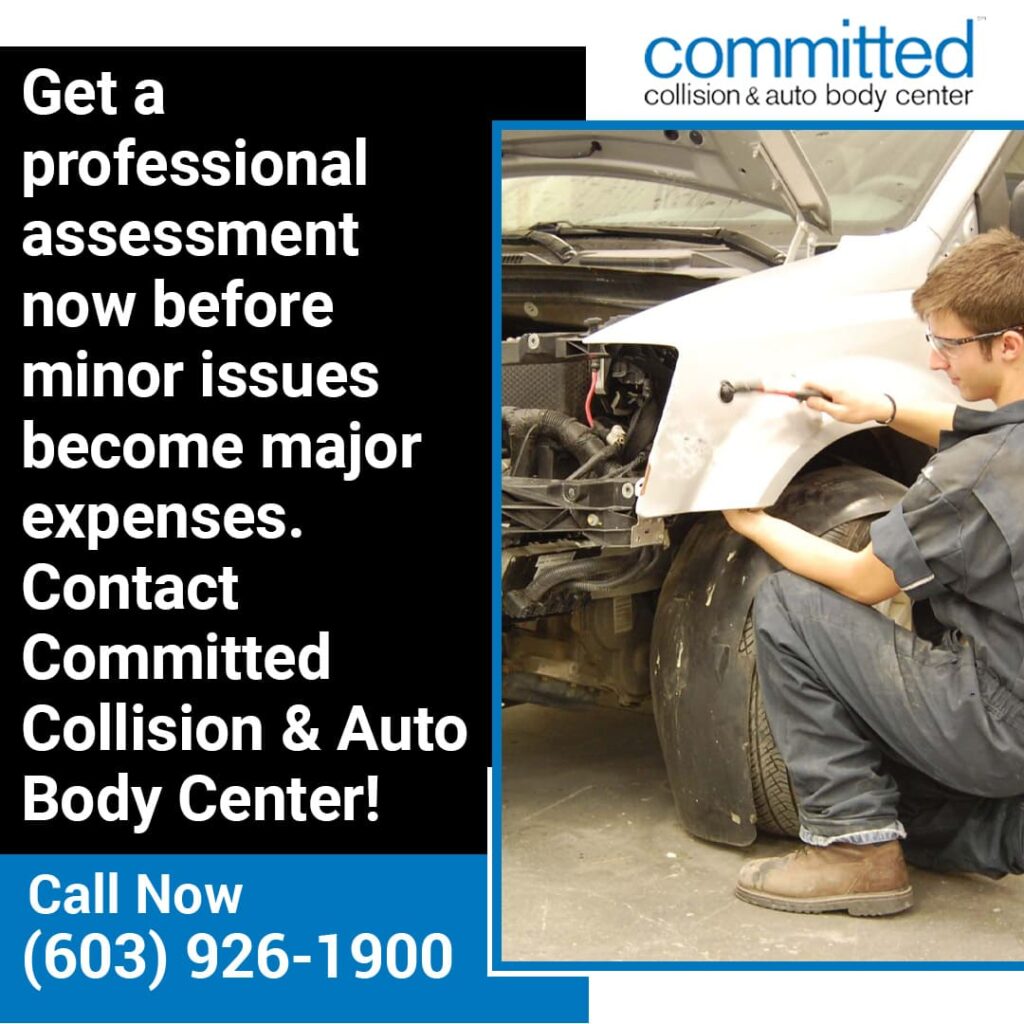
Get Those Old Scratches and Dents Fixed With Professional Auto Body Repair at Committed Collision & Auto Body Center
Your old scratch or dent likely isn’t beyond professional correction, but continued delays increase both complexity and investment required. Early intervention stops oxidation spread while preserving your vehicle’s safety characteristics and market value. Contemporary vehicles require sophisticated equipment and trained technicians for proper restoration.
Professional assessment reveals the true extent of auto body damage and determines optimal correction approaches. Whether you need surface refinishing, dent removal, rust treatment, or structural restoration, Committed Collision & Auto Body Center possesses the expertise and equipment to restore your vehicle to pre-incident condition.
Contact our North Hampton shop at (603) 926-1900 or email info@committedcollision.com for professional auto body repair. We’ll inspect your vehicle, explain our findings, and provide a detailed assessment for restoring your car properly. Don’t allow old damage to become bigger problems. Our family is ready to help yours.