
Synopsis
OEM parts are built to the exact specifications your vehicle left the factory with. In professional auto body repair, that precision determines crash safety, paint durability, structural integrity, and resale value. Here is what NH Seacoast drivers need to know before authorizing any collision repair.
OEM (Original Equipment Manufacturer) parts are built to the exact specifications your vehicle left the factory with. In professional auto body repair, that precision directly affects crash safety, paint durability, and what your car is worth long after the repair is done.
After a collision, the parts that go back into your vehicle matter as much as the technicians installing them. At Committed Collision & Auto Body Center, we have served NH Seacoast drivers since 2005, bringing over 70 years of combined family auto body experience to every job. We have seen how the wrong replacement parts, even ones that look correct from the outside, can quietly undermine a vehicle’s frame integrity, finish quality, and long-term value.
For drivers seeking auto body repair in North Hampton, NH, whether for frame straightening, structural repair, collision damage repair, or paint and finish restoration, knowing why factory-grade parts matter is part of making a fully informed choice.
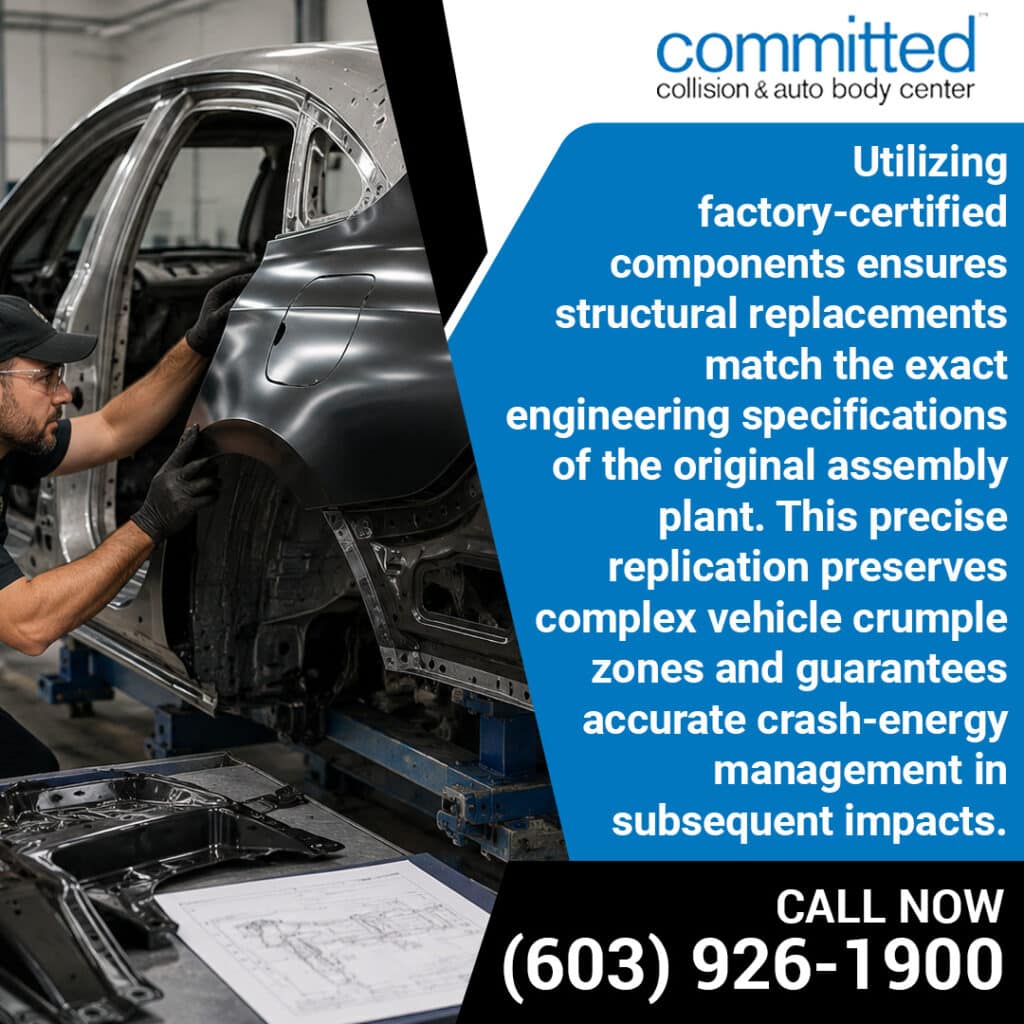
What Are OEM Parts and What Are They Not?
OEM parts are produced by or for the vehicle manufacturer under the same engineering specifications used at the assembly plant. They match the original component in dimensions, material composition, weight distribution, and finish, exactly as the vehicle was built.
Aftermarket parts are made by independent, third-party manufacturers. They are designed to approximate the original but are not manufactured to factory standards. Quality varies widely across suppliers. Without independent certification, fit, material strength, and long-term durability cannot be confirmed.
A third category includes recycled or LKQ (Like Kind and Quality) parts, which are original OEM components removed from donor vehicles. Another category is remanufactured parts, which are previously used components that have been rebuilt, tested, and restored to specified performance standards. Depending on the repair, both may be appropriate in certain applications, although structural and safety-critical repairs should always follow the vehicle manufacturer’s repair procedures.
We source replacement parts directly from vehicle manufacturers or trusted, vetted suppliers. We do not purchase repair-critical parts from unverified online marketplace sellers. That standard applies to every repair we complete at our auto body repair shop, regardless of the size or scope of the job.
Why OEM Parts Are the Standard in Professional Auto Body Repair
Fit and Finish Built to Factory Tolerances
Factory parts are engineered to match the exact dimensions of what they replace down to fractions of a millimeter. Proper panel alignment depends on this precision. A door skin, quarter panel, or bumper assembly that falls outside factory tolerances creates visible gaps. Beyond appearance, those gaps compromise water sealing and accelerate corrosion, a real concern for vehicles driven on NH coastal roads.
CAPA (Certified Automotive Parts Association), an independent nonprofit, evaluated 15 popular non-certified aftermarket parts and found problems in nearly all of them. Nearly 90% fell short of factory standards, showing material substitutions, weaker striker retention, and non-galvanized metals prone to early rust.
We use the Chief 3D Laser Measuring System and Spanesi Touch Measuring System to verify alignment on every collision repair, supported by Spanesi Multibench pull stations for frame straightening. That level of measurement precision only delivers accurate results when the replacement parts meet the same engineering standard.
Structural Integrity and Crash Safety
Modern vehicles are engineered with precise crumple zones, load paths, and energy-absorption sequences. The pillars, rails, and reinforcements forming your vehicle’s safety cage are designed to work together in a specific sequence during impact. A replacement component that differs in material thickness, hardness, or geometry, even slightly, can alter how that sequence unfolds in a second crash.
A 2018 Insurance Institute for Highway Safety (IIHS) advisory has stated clearly that structural replacement parts must be an exact match to the original to preserve a vehicle’s crash performance. Many aftermarket suppliers build these parts to their own internal guidelines, with no required equivalence to the original design.
Compatibility with Advanced Safety Systems
Late-model vehicles carry ADAS (Advanced Driver Assistance Systems): radar units, cameras, and sensors in tightly toleranced housings. A factory bumper cover or grille is built around the precise position of the radar module behind it. A non-factory replacement with a different depth or material density can disrupt sensor accuracy, even after recalibration.
For ADAS recalibration following collision repair work, Committed Collision & Auto Body Center works closely with Automotive Alignments & Calibrations LLC. Their team uses Hunter/Bosch DAS 3000 calibration equipment and a full Hunter Alignment System with an in-ground rack. Installing correctly specified parts from the start is what makes that calibration hold.
OEM Parts, and Paint and Finish Restoration
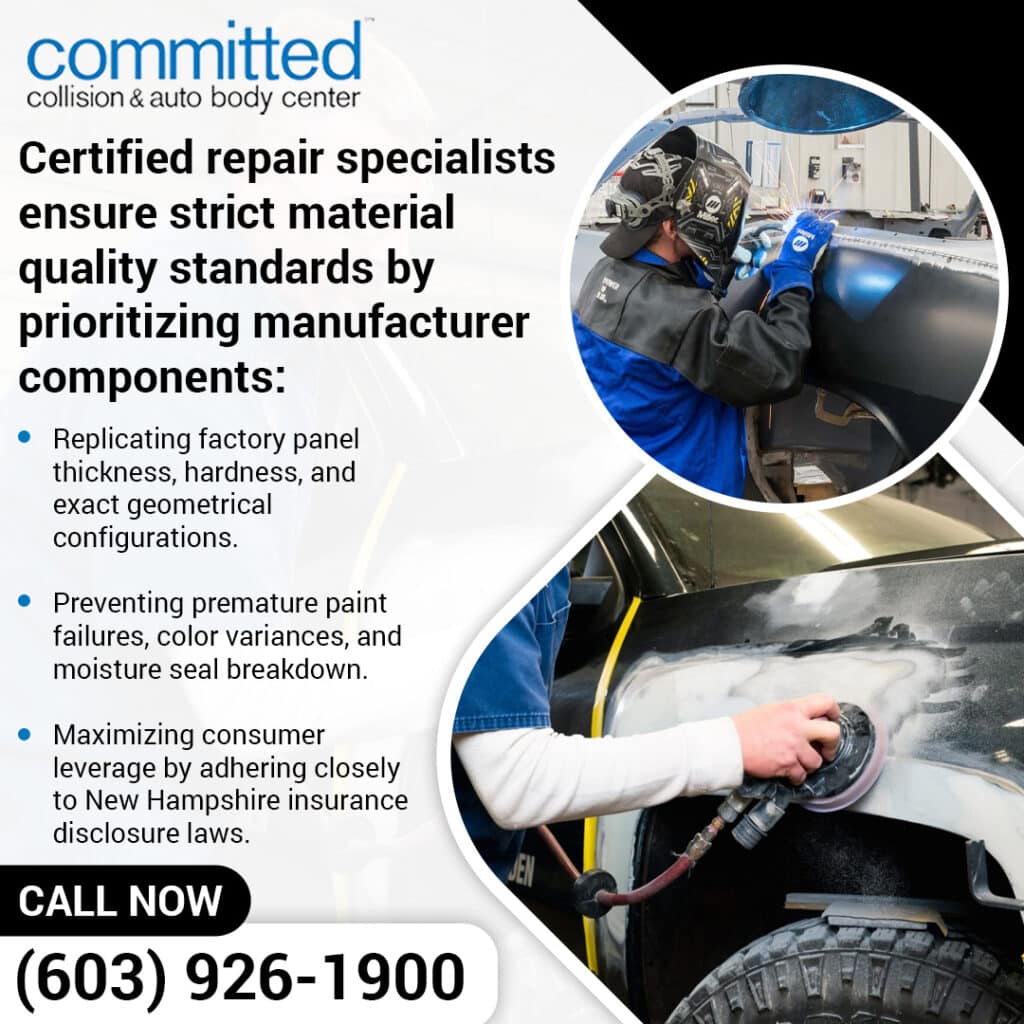
A panel’s substrate, its alloy, polymer, or composite makeup, determines how well paint adheres and how long it holds. Factory panels are manufactured from specific materials that interact predictably with primer, base coat, and clear coat at every stage of refinishing. Non-factory panels made from different substrates can lead to premature peeling, micro-blistering, or color shift that shows up months after the vehicle leaves the shop.
At Committed Collision & Auto Body Center, we apply Glasurit 100 Line waterborne paint that is used by over 80% of OEM manufacturers. It goes through three USI Spray Booths, with a bake cycle that fully cures each coat. For minor damage where panel replacement is not needed, our technicians use the Keco PDR and Glue Pull Station for paintless dent repair, preserving the original factory finish without repainting. Both methods deliver their best results on panels built to the correct material specifications.
With NH Seacoast summers bringing peak UV exposure, clear coat longevity on factory-spec panels is more reliable than on aftermarket alternatives with unknown substrate compositions.
What Is at Risk When OEM Parts Are Skipped
The effects of non-factory parts are not always visible at pickup. Here is where they tend to appear:
- Resale value: Appraisers and buyers identify non-factory collision repairs through panel fit and paint consistency during inspection. On late-model vehicles, these findings can reduce trade-in and private sale value.
- Manufacturer warranty: Non-factory parts used in a covered repair can affect warranty standing on related systems, depending on the vehicle manufacturer and the component involved.
- New Hampshire consumer protections: New Hampshire RSA 407-D prohibits insurers from requiring aftermarket parts on vehicles placed in service within the past two years with 30,000 miles or fewer. Insurers specifying aftermarket parts must disclose this in writing on the estimate. Insurers who fail to provide this precise disclosure are prohibited from requesting or requiring aftermarket parts altogether.
- Repair warranty: Our professional auto body repair is backed by a limited lifetime warranty covering workmanship, paint, and part performance, valid for the duration of your ownership of the vehicle.
How to Verify That Your Auto Body Repair Shop Uses OEM Parts
Ask these questions before authorizing any collision repair:
- Do you prioritize factory parts, and will you provide a written parts list before work starts?
- Are you I-CAR Gold Class certified? (I-CAR Gold Class requires ongoing OEM repair procedure training.)
- Do your technicians follow the vehicle manufacturer’s repair procedures for my specific vehicle?
- What warranty do you provide on parts, paint, and workmanship?
Red flags include vague answers about parts sourcing, no repair plan provided before work begins, and no mention of manufacturer procedures. A shop holding I-CAR Gold Class certification and staffed by ASE-certified technicians who receive yearly training is one operating to manufacturer standards, not shortcuts.
As a trusted auto body shop in North Hampton, NH, for over two decades, Committed Collision & Auto Body Center meets every one of those standards. We give every customer a detailed, itemized repair plan with all parts listed by type before work begins. We also work with all major insurance providers to document and advocate for the correct components on your behalf. Here is a review by our customer Keegan R., “They took care of an insurance claim for my truck in January and did a great job. I had specialty headlights replaced, which later on ended up failing. I contacted Committed Collision, and they handled the warranty claim with the manufacturer and got me back in right away with the new part for installation. They listened to my attention-to-detail specific requests and installed them exactly as I requested, and all the warranty work was no cost to me. They also cleaned the inside and outside of my truck both times they had it – these little things make a huge difference, and I am blown away!”
OEM vs. Aftermarket Parts: Key Differences
| Factor | OEM / Factory Parts | Non-Certified Aftermarket |
| Fit and tolerances | Meets exact factory specifications | Fit and finish vary; not verified |
| Crash performance | Designed to original equipment safety standards | No OE-certified performance requirement |
| Paint adhesion | Consistent substrate composition | Variable; may affect long-term finish |
| ADAS compatibility | Matches sensor housing tolerances | Fitment variance may impact sensor readings |
| Manufacturer warranty | Includes OEM warranty coverage | Limited or no manufacturer warranty |
| NH RSA 407-D disclosure | Insurer must disclose non-OEM use | Must meet “like kind and quality” by law |
| Resale value | Maintains factory-condition status | May be noted as non-OEM on recent vehicles |
Frequently Asked Questions
What does OEM mean in auto body repair?
OEM stands for Original Equipment Manufacturer. These parts are produced to the exact engineering specifications of the components your vehicle left the factory with; same materials, same tolerances, same fit. They come from the vehicle manufacturer or a supplier contracted to meet those standards.
Are OEM parts always required for collision repairs?
Not always required by law, but vehicle manufacturers strongly recommend them for all collision repairs. In New Hampshire, insurers cannot require aftermarket parts on vehicles placed in service within the past two years with 30,000 miles or fewer, per RSA 407-D:3-a. For other vehicles, any aftermarket part used must meet a like-kind-and-quality standard in fit, quality, and performance. We always discuss your options and advocate for the correct parts with your insurer.
Will my insurance cover OEM parts?
Coverage depends on your policy. Some policies specify factory-grade parts; others default to aftermarket parts to reduce claim costs. Under NH RSA 407-D:4, your insurer is required to disclose in writing any estimate that uses aftermarket parts. Failing to provide that disclosure is a violation of NH insurance law, subject to penalties under RSA 417.
Do the parts used in a collision repair affect resale value?
Yes, particularly on late-model vehicles. Appraisers assess panel fit, paint uniformity, and repair quality during inspection. A vehicle repaired with factory-grade parts holds its appraised value more reliably than one repaired with non-certified alternatives.
How do I find a reliable shop for auto body repair in North Hampton, NH?
Request a written repair plan listing all parts by type before work begins. A shop holding I-CAR Gold Class certification is a reliable indicator of a facility operating to manufacturer standards. ASE certification adds a further layer of verified technical competence.
Schedule Your Auto Body Repair in North Hampton, NH
The components installed in a collision repair shape how your vehicle performs if struck again, how long the refinish holds, and what the car is worth at trade-in. Proper auto body repair starts with parts built to your vehicle’s original specifications, documented before any work begins.
Committed Collision & Auto Body Center holds I-CAR Gold Class certification, employs ASE-certified technicians, works with all major insurance providers, and backs every repair with a limited lifetime warranty on workmanship, paint, and part performance. Contact us at (603) 926-1900 or info@committedcollision.com for a free, no-obligation estimate.