
Synopsis
After a collision, your vehicle’s electronic systems may be compromised even when body damage looks minor. Committed Collision & Auto Body Center explains why diagnostic scanning is a required part of every professional repair and what is at risk when a shop skips it.
A modern vehicle is far more than its exterior. Beneath the panels and paint, dozens of electronic control units (ECUs) manage everything from engine output to airbag deployment. A collision, even one that seems minor, can disrupt these systems without leaving any sign you can see from the outside.
Committed Collision & Auto Body Center performs electronic diagnostic scans at two critical points in every repair: before we disassemble your vehicle, and again after all repairs are complete. This is not an optional step. It is how we catch what a visual inspection cannot find, and how we verify that your vehicle is genuinely safe when it leaves our shop.
If you are looking for auto collision repair in North Hampton, NH that goes beyond surface-level fixes, understanding why diagnostic scanning matters will help you ask the right questions before you hand over your keys.
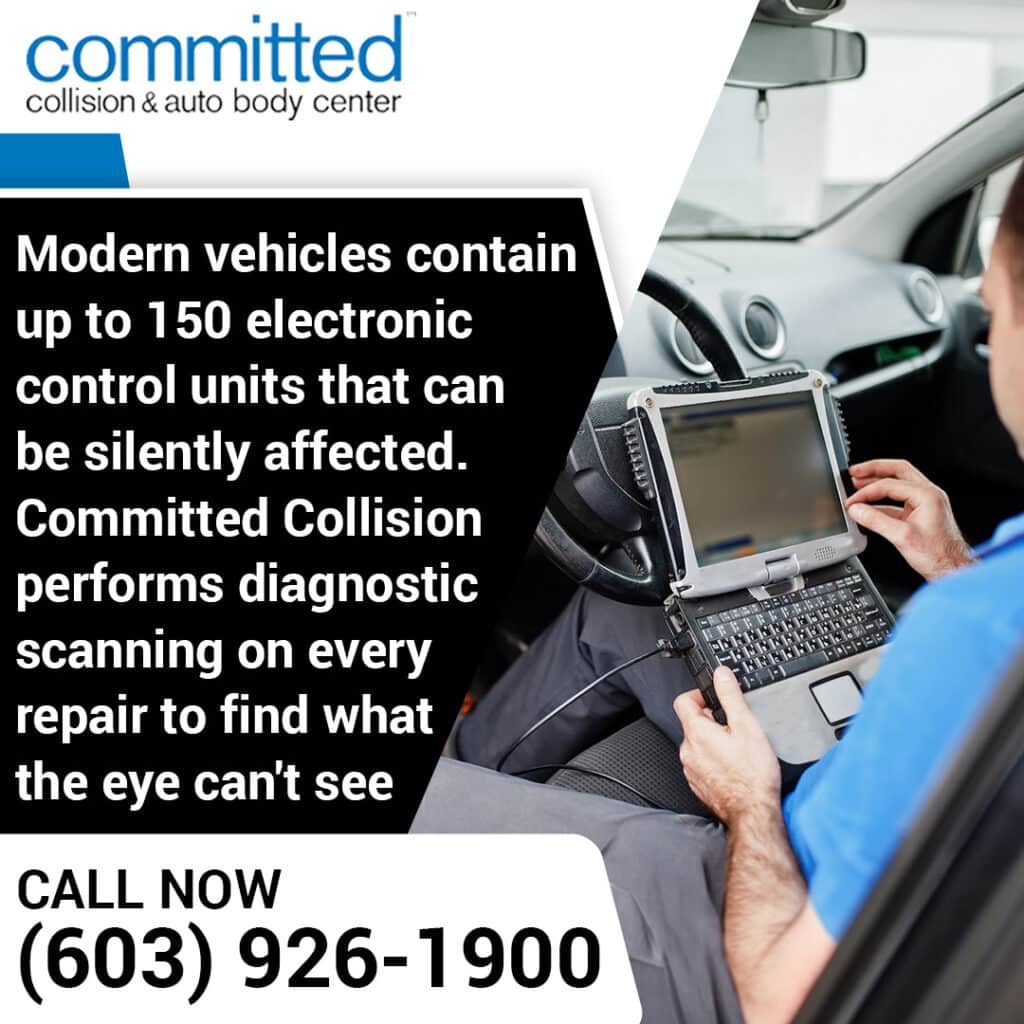
What a Post-Collision Diagnostic Scan Actually Does
A diagnostic scan reads your vehicle’s onboard computer systems to identify electronic faults that occurred during a collision, including those that produce no visible warning.
Most vehicles built in the last two decades use a standardized diagnostic interface called OBD-II (On-Board Diagnostics II). This system continuously tracks vehicle functions and logs Diagnostic Trouble Codes (DTCs) whenever a sensor, module, or system moves outside its normal operating range. A professional scan tool connects to this interface and pulls those codes for review.
What Gets Checked
A full diagnostic scan covers a wide range of vehicle systems, including:
- Engine control module (ECM)
- Airbag and occupant restraint systems
- Anti-lock braking system (ABS)
- Transmission control module
- Steering angle sensor
- Suspension control systems
- Advanced Driver Assistance Systems (ADAS)
- Lighting and body control modules
No amount of visual inspection tells us whether these systems were affected by a collision. Our collision repair specialists rely on OEM-approved scan tools and the training to read what the results mean for your specific vehicle to get that answer.
Why Collision Damage Goes Deeper Than the Surface
The force of a collision travels through a vehicle’s structure in ways that affect wiring, sensors, and control modules well beyond the point of visible impact.
Modern vehicles may contain dozens of electronic control units (ECUs), with many passenger vehicles typically operating between 30 and 80 modules, while some high-end models can exceed 100, depending on system complexity. These modules are networked together, and a disruption to one can affect the behavior of others. Impact energy moving through the frame can damage wiring harnesses, shift sensors out of their calibrated positions, or cut off signal paths between modules, all without cracking a panel or breaking a light.
What makes this especially relevant in body collision repair is that fault codes do not always surface immediately. Some appear days or weeks after a repair. Others suppress temporarily and return once the vehicle is driven under certain conditions.
Faults that commonly go undetected without scanning include:
- Airbag system errors from impact-triggered sensors
- Steering angle sensor misalignment from a struck wheel or suspension component
- Radar or camera displacement affecting ADAS performance
- Wiring faults between control modules caused by frame movement
- Crash sensor deactivation that may prevent future airbag deployment
The table below shows how electronics-dependent today’s vehicles have become:
| Fact | Source |
| Modern vehicles can contain up to 150 ECUs; most standard models run 30–80 modules | Wikipedia |
| Five core ADAS features each reached 91–94% market penetration in 2023 model year U.S. vehicles | PARTS Report |
That prevalence is exactly why a scan is not optional when we receive a late-model vehicle after a collision. The more electronic systems a vehicle carries, the more a diagnostic scan reveals what no visual inspection can.
Manufacturer Standards Require Scanning Before and After Repairs
Many OEM repair procedures recommend or specify pre- and post-repair diagnostic scanning as part of proper collision repair, depending on the vehicle and type of damage.
This requirement exists because manufacturers know what happens when sensors and modules are subjected to collision forces. Pre-repair scanning documents, for which fault codes were already present at drop-off. Post-repair scanning confirms that every identified issue was resolved and that the repair itself introduced no new codes.
Which Repairs Trigger a Scanning Requirement
Manufacturers commonly require diagnostic scanning after:
- Collision repair of any severity, including minor impacts
- Windshield replacement, because forward-facing cameras must be rechecked
- Suspension or alignment work that could shift sensor positions
- Replacement of any safety system component or control module
Vehicle manufacturers, including Ford, GM, Toyota, Hyundai, Mazda, and Nissan, have each published official position statements on this requirement. Performing auto collision repair without documented pre- and post-repair scans means the vehicle is not being serviced to the standards its manufacturer set, and that is a standard we follow for every repair.
How Scanning Fits Into Our Repair Process
We perform diagnostic scanning at two defined points in our repair workflow, not as a final formality, but as an active part of how repairs are planned and verified.
Before Disassembly: The Pre-Repair Scan
Once your vehicle is checked in, we run a full OBD-II diagnostic scan using OEM-approved equipment before any disassembly begins. This gives us a documented record of every stored fault code at drop-off and flags electronic damage that is not visible during the initial inspection; both of which directly shape the repair plan.
We use factory-level scan tools for Hyundai, Kia, GM, Ford, Toyota, Mazda, and Nissan vehicles, along with OEM-approved OBD-II equipment for other makes. Factory tools retrieve manufacturer-level data rather than generic codes, which allows our technicians to identify vehicle-specific fault conditions with precision.
After Repairs Are Complete: Post-Repair Diagnostic Testing
Once all body, structural, and paint work is finished and your vehicle has been fully reassembled, a second scan runs as part of our quality control process. This confirms:
- All DTCs recorded at drop-off have been addressed
- Every system is operating and communicating within factory specifications
- The repair process itself generated no new fault codes
That final scan is what separates a repair that is genuinely complete from one that only looks finished.
ADAS Calibration After Scanning
When post-repair scanning shows that ADAS sensors or cameras need recalibration, we coordinate directly with Automotive Alignments & Calibrations LLC, our sister company at the same location. Their team handles post-collision ADAS calibration using Hunter/Bosch DAS 3000 equipment and a Full Hunter Alignment Machine with an in-ground rack. Calibration always follows scanning, not the other way around, because calibrating a system with an unresolved fault code produces an unreliable result.
Why ADAS Systems Make Scanning Non-Negotiable
A vehicle’s safety assistance features are only as reliable as the sensors feeding them data, and a collision can compromise those sensors without triggering a single dashboard warning.
ADAS is the collective name for features now standard on most late-model vehicles, including:
- Automatic emergency braking
- Lane departure warning
- Adaptive cruise control
- Blind spot monitoring
- Rear cross-traffic detection
These systems depend on cameras, radar, LiDAR, and sonar that are calibrated to work within precise positioning tolerances. A collision can shift these sensors enough to degrade system performance while leaving no visible sign that anything changed. The vehicle appears to function normally. The ADAS features appear active. But the data driving them may be off.
IIHS research shows how much is at stake when these systems work correctly and what is lost when they do not:
| ADAS Technology | Documented Safety Benefit |
| Automatic emergency braking | Reduces rear-end crashes by up to 50% |
| Lane departure warning | Reduces crashes of all severities by 11%; injury crashes by 21% |
A scan before calibration is not optional. It is what makes calibration reliable. When we identify sensor or camera faults through post-repair scanning, that information goes directly to Automotive Alignments & Calibrations LLC before any calibration work begins. Scanning and calibration are sequential by design, not interchangeable.
What Happens When a Car Collision Repair Shop Skips Diagnostic Scanning
The consequences of skipping pre- or post-repair scanning fall into three categories.
Undetected Safety System Faults
Airbag systems, stability control, and automatic braking depend on sensors that a collision can knock out of range. When those faults go unresolved, the systems may not perform correctly in a future accident, with no warning beforehand.
Fault Codes That Return After Pickup
Stored codes that were not corrected during a repair will resurface once the vehicle is back on the road. Drivers often return to shops with warning lights that appeared shortly after pickup. Without scan records from both points in the repair, neither the shop nor the driver can easily trace when the fault originated.
Incomplete Repair Documentation
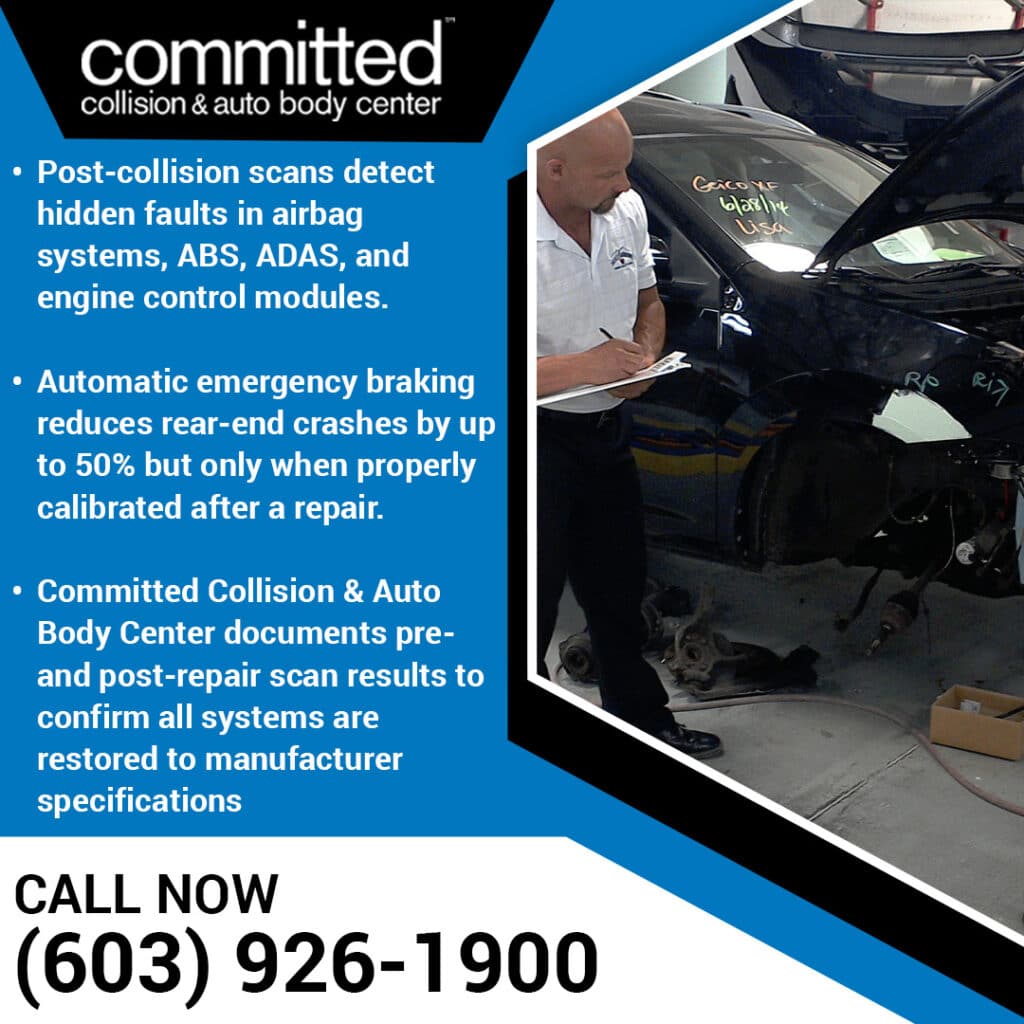
A professional car collision repair shop documents pre- and post-repair scan reports as part of every completed repair record. We do this for every vehicle. Those records confirm the electronic condition at drop-off and at delivery. Without them, there is no verifiable basis for the repair being complete, which matters for your protection and any future insurance or warranty questions.
Questions to Ask Any Collision Shop About Diagnostics
Before choosing where to take your vehicle for body collision repair, ask the shop these questions directly:
- Do you perform a pre-repair OBD-II scan before disassembly?
- Do you run a final diagnostic scan before the vehicle is returned?
- What scan tools do you use, and are they approved for my vehicle’s make?
- How do you handle ADAS recalibration when sensors are affected?
A shop that treats scanning as a standard part of every repair will answer these specifically. One that does may not be able to answer them at all.
Our collision repair specialists hold I-CAR Gold Class and ASE certifications, and receive ongoing training to stay current with the electronic systems on today’s late-model vehicles. We serve drivers throughout the New Hampshire Seacoast and surrounding Southern NH communities. Here is a review from one of our customers: “I scheduled 2 of our vehicles for inspections and repairs and was blown away by the communication, the education, and the value. All auto repairs can be sticker shock inducing, however the people at Committed Collision were able to explain the reasoning behind their recommended repairs. They also allowed for me to take my vehicle elsewhere to go out for a second opinion. No pressure, just calm reasoning. I felt very comfortable with their service. I will be going back and recommend others do as well.” – N. Bridle
Diagnostic Scanning Completes Collision Repair
A vehicle that looks repaired and a vehicle that has been fully restored are not always the same thing. Scanning before and after every repair is what bridges that gap.
For drivers with late-model vehicles who need auto collision repair, choosing the best collision repair shop in North Hampton, NH, means choosing one that treats electronic diagnostics as a standard step, not an upgrade. It is the only way to know that every system in your vehicle is working the way it was designed to.
Request a free estimate or schedule your repair today. Call Committed Collision & Auto Body Center at (603) 926-1900 or email us at info@committedcollision.com. We will explain the full repair process and answer any questions before work begins. Our team of dedicated and skilled technicians helps you with all of your auto body, collision, and mechanical repair needs.