
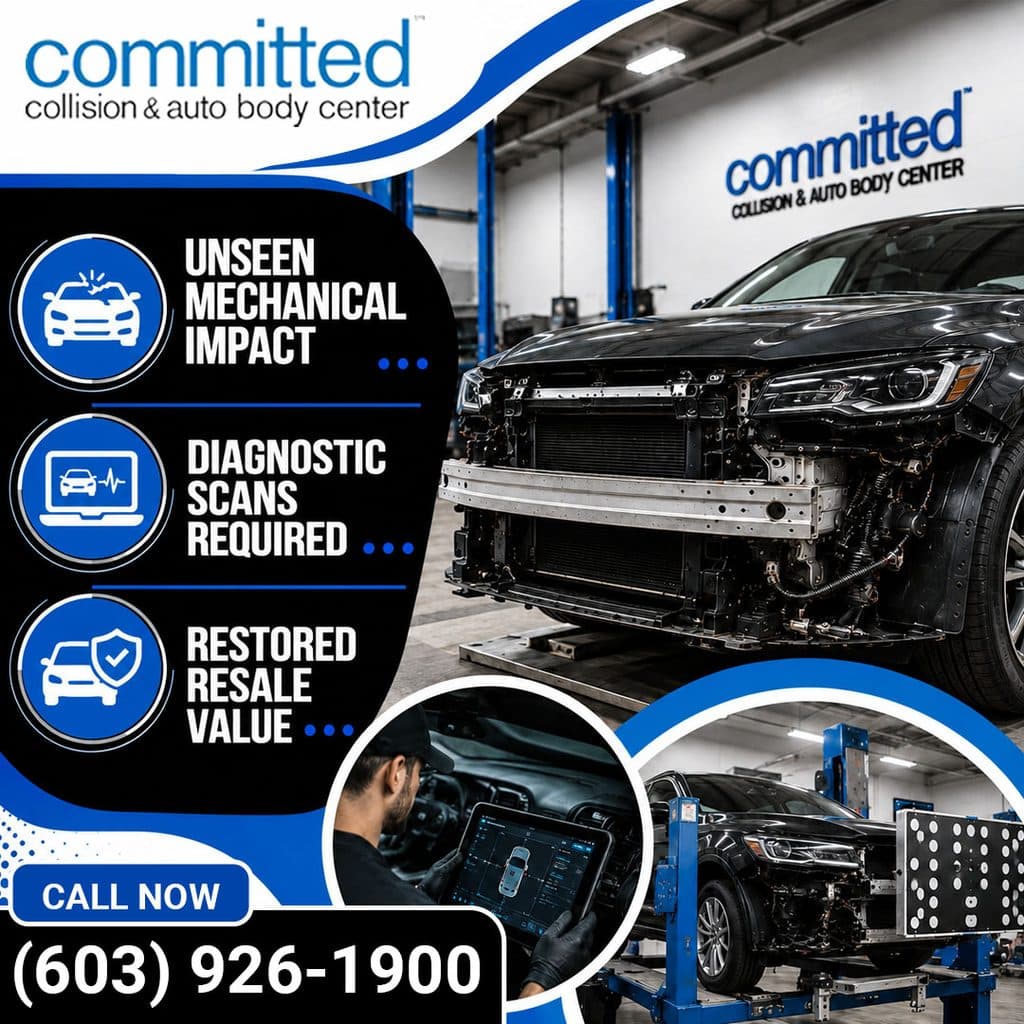
Your steering, engine mounts, cooling lines, and wheel alignment can take damage in a collision without a mark on the body panels. At Committed Collision & Auto Body Center, we recommend a full diagnostic scan after any impact, even low-speed, so we can flag any auto mechanical repair that North Hampton, NH drivers need before it goes unnoticed.

Key Takeaways
- Hidden force travels inward: The energy from your collision passes through the frame into the steering system, drivetrain, and engine mounts too.
- Scans catch what eyes cannot: Nearly 70% of repairable estimates now include a diagnostic scan, per CCC Intelligent Solutions data.
- A trusted car mechanic matters: At Committed Collision & Auto Body Center, we work closely with Automotive Alignments & Calibrations LLC for the mechanical repair a collision can require.
What Mechanical Systems Get Damaged Beyond the Body Panels?
In a collision, force travels past your bumper into the steering rack, drivetrain, engine mounts, cooling system, and exhaust. At Committed Collision & Auto Body Center, we also watch for wheel alignment shifts, since these happen even with clean paint.
Steering, Drivetrain, and Engine Components
When we inspect a vehicle after a hard impact, we often find a bent tie rod, a cracked CV axle, or a driveshaft damaged with no outward sign. Engine and transmission mounts hold the powertrain in place, and a shifted mount often shows up later as vibration at idle. We also check radiators and cooling lines, since a front-end hit can crack them. Exhaust parts can be knocked loose, and wheel alignment shifts in most collisions involving the wheels or suspension.
None of these show on your bumper cover, which is why we treat a scan and road test as seriously as the visual estimate.
How Do Auto Mechanical Diagnostics Find Damage a Visual Check Misses?
Our auto mechanical diagnostics rely on OBD-II scan tools, a raised inspection, and a road test to catch what a walk-around misses. A scan reads stored codes; a road test catches vibration or noise under load.
What Each Diagnostic Step Reveals
| Diagnostic Step | What It Reveals |
| OBD-II scan | Stored fault codes from the engine, transmission, and safety systems |
| Raised inspection | Bent components, fluid leaks, and loose mounts |
| Road test | Vibration, pulling, or unusual noise under driving conditions |
General Auto Repair vs. Auto Mechanical Repair After a Collision
General auto repair covers routine maintenance, like oil changes and tire rotations, on a set schedule. We know that auto mechanical repair after a collision must be treated differently, starting from your specific impact.
| Feature | Routine Auto Repair | Post-Collision Mechanical Repair |
| Trigger | Mileage or time interval | A specific impact event |
| Starting point | Scheduled checklist | Diagnostic scan and road test |
| Common systems checked | Fluids, brakes, tires | Steering, mounts, alignment, cooling |
A scan can flag a code without showing urgency, so explain what you should check first.
What Should You Do If You Suspect Mechanical Damage After an Accident?
If you notice a pull, vibration, or warning light after a collision, take these steps.
- Schedule a full diagnostic inspection soon after the accident, even if it drives normally, since symptoms can take days to appear.
- Ask a trusted car mechanic to road test your vehicle and check for stored codes tied to steering, transmission, or emissions.
- Confirm alignment and calibration needs once body and structural repairs are complete, since these steps typically come last.
Frequently Asked Questions
Will insurance cover mechanical damage found after the initial estimate?
Coverage for supplemental findings depends on your policy; ask your adjuster once diagnostics confirm it. A written plan supports the request.
Does hidden mechanical damage affect my vehicle’s resale value?
Yes. A vehicle with hidden mechanical or structural damage from a previous accident may have a lower resale value. The more severe the damage, the greater the potential impact on the vehicle’s market value. Accident history can also make buyers more cautious, even when repairs have been completed.
Can a vehicle pass state inspection with undiagnosed collision-related mechanical damage?
It depends on the system. Brake, steering, or emissions damage likely triggers a failure; a stressed mount may not.
Ready to Schedule a Mechanical Inspection After Your Collision?
At Committed Collision & Auto Body Center in North Hampton, NH, we start every estimate with a visual inspection of panels, bumpers, and wheels, then work closely with Automotive Alignments & Calibrations LLC once damage turns up. Contact us at (603) 926-1900 or info@committedcollision.com, and we will have your vehicle checked by a trusted car mechanic before small damage grows.