
Synopsis:
Collision repair and general auto repair serve distinct roles, yet many drivers confuse the two after an accident. Southern New Hampshire’s top-rated collision repair specialist explains how collision repair restores structural integrity and safety systems, why routine repairs are not enough after a crash, and how choosing the right repair approach directly impacts vehicle safety and long-term performance.
After an accident, most vehicle owners focus on visible damage. A dented panel or cracked bumper often feels like the main concern. In reality, what you cannot see is usually more important. Modern vehicles are built with layered structures and advanced safety systems that absorb impact in ways that are not always obvious.
Drivers may make a costly mistake of assuming that any repair shop can fix post-accident damage. In practice, the type of repair your vehicle needs depends on what caused the damage in the first place.
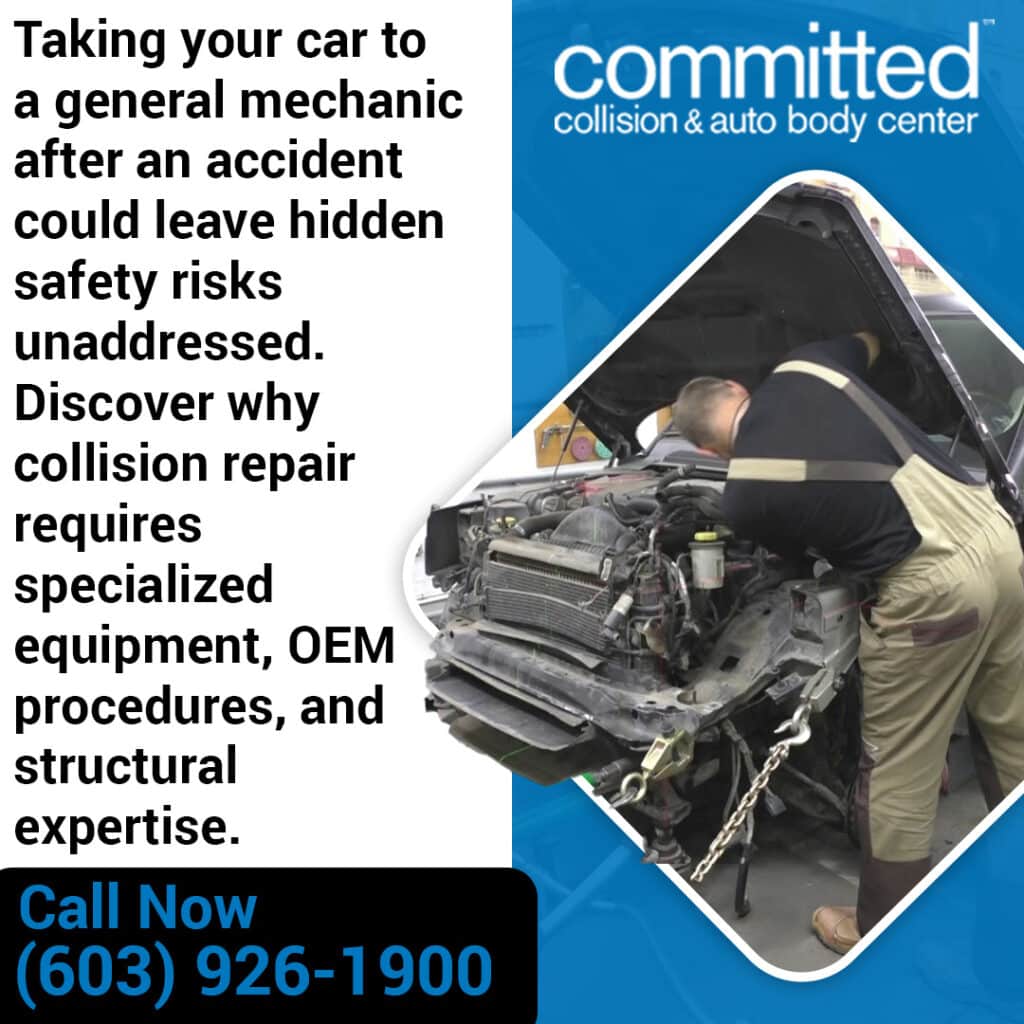
At Committed Collision & Auto Body Center in North Hampton, NH, we see this confusion often. Drivers come in after visiting a general repair shop, only to learn that structural or safety-related issues were never addressed. That gap can affect how your vehicle performs in another collision.
Auto collision repair focuses on restoring a vehicle after an accident, while general auto repair handles maintenance and mechanical wear. Knowing the difference helps you choose the right shop and protect both your safety and your vehicle’s long-term value.
What Is Auto Collision Repair?
Auto collision repair is the process of returning a vehicle to its pre-accident condition by addressing structural damage, body panel repair, and safety system issues caused by a collision.
It goes well beyond what’s visible on the surface. A fender that looks slightly off may be hiding a bent frame. A bumper that popped back into place may be concealing damage to the crash bar underneath. That’s why a proper collision repair begins with a visual inspection and estimate, then moves to pre-washing, scanning, and full disassembly once the repair is authorized and the vehicle is dropped off.
Here is what the process covers:
- Frame and structural repair: Measuring and correcting the chassis and frame to manufacturer specifications
- Body panel work: Repairing or replacing panels, auto glass, and lights damaged in the crash
- Pre- and post-repair scanning: Using OEM-approved OBD-II tools to document all diagnostic trouble codes at intake and verify they are resolved after repairs
- Paint and refinishing: Restoring the vehicle’s color and protective coating to factory standards
- ADAS evaluation: Assessing whether cameras, radar, or sensors were displaced and coordinating any required recalibration through our sister company, AAC
What Makes Collision Repair Different From Basic Repairs?
Collision repair is safety-critical work that follows OEM-specific procedures and requires specialized equipment that most general shops don’t have.
A standard mechanic is not trained to straighten a vehicle’s frame, match factory paint, or recalibrate a forward-collision radar system. Collision repair technicians train specifically for those tasks and follow manufacturer repair procedures for each vehicle make and model, procedures that define exactly how a vehicle must be restored to maintain its structural performance and safety rating.
What Is General Auto Repair?
General auto repair covers the scheduled maintenance and mechanical fixes a vehicle needs throughout its service life.
This includes oil and fluid changes, brake pad and rotor replacement, tire rotations, battery and alternator service, and exhaust repairs. These are valuable services, but routine mechanical work alone is not what a vehicle needs after a crash. A shop focused only on general maintenance is not equipped to assess post-accident structural damage, uncover hidden crash damage through disassembly, or restore safety systems disrupted by an impact.
Accident-related mechanical repairs are a different matter and must be part of a complete collision repair process.
Key Differences Between Collision Repair and Auto Repair
Type of Damage Handled
| Collision Repair | General Auto Repair | |
| Cause of damage | Accident and impact | Wear, age, and mechanical failure |
| Examples | Bent frame, crumpled panels, sensor displacement | Worn brakes, fluid leaks, dead battery |
| Safety systems addressed | Structural integrity, ADAS sensors, airbag systems | Brakes, tires, and lighting components |
| Disassembly required | Yes, to document all hidden damage | Only when diagnosing specific mechanical faults |
Tools and Technology Used
Collision repair requires equipment that goes well beyond what a general shop carries:
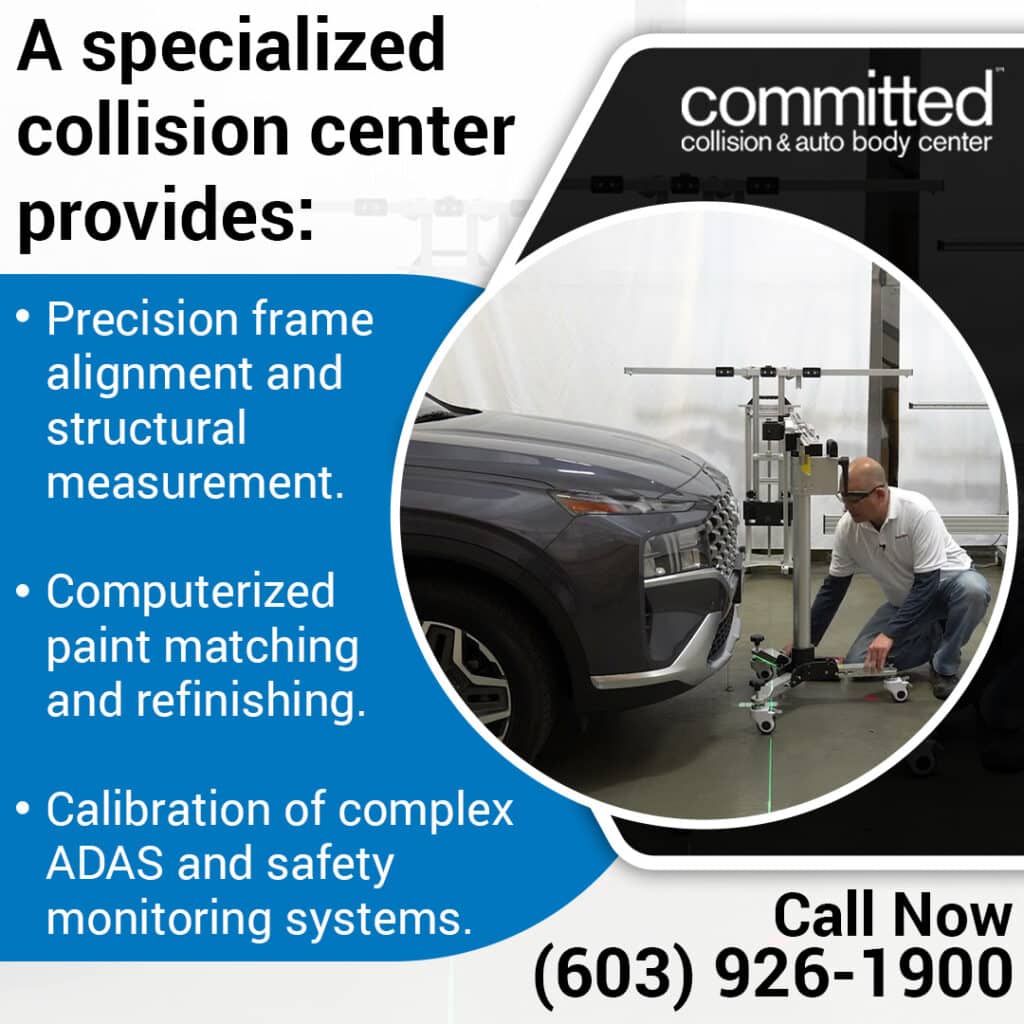
- Frame measuring and pulling systems: To detect and correct structural shifts invisible to the naked eye
- Computerized paint matching and spray booths: For factory-accurate color and finish restoration
- OEM scanning equipment: To capture all diagnostic fault codes before and after repairs
- ADAS calibration platforms: Used by our sister company AAC to restore sensor alignment to manufacturer specifications
Skillset and Training
A collision repair specialist and a general mechanic hold different certifications, train for different tasks, and work with different equipment.
Collision technicians train in structural repair, metalwork, refinishing, and vehicle diagnostics. The I-CAR Gold Class designation is the industry benchmark for collision facilities, requiring ongoing training as repair methods evolve. ASE certification covers mechanical expertise and applies across both fields.
Why Choosing the Right Repair Matters After an Accident
When accident damage isn’t fully repaired, the consequences don’t always show up right away, but they affect your vehicle’s safety when it counts most. This is why auto collision repair includes full structural inspection, diagnostics, and safety system evaluation before any work begins.
A frame that’s slightly out of alignment changes how the vehicle distributes impact force in a future collision. A sensor off by a degree or two may still appear to function, yet give your safety system inaccurate data. Neither problem shows up on a routine service checklist, which is why full disassembly before writing a repair plan is not optional.
Impact on Vehicle Safety Systems
Advanced Driver Assistance Systems can be disrupted by a collision even when the impact looks minor.
Lane departure warnings, automatic emergency braking, adaptive cruise control, and blind spot monitoring all depend on sensors that must be precisely positioned. Caliber projected that 65% of collision repairs would need ADAS calibration in 2026; actual demand reached 65% by Q2 2025.
At Committed Collision & Auto Body Center, body collision repair always includes pre- and post-repair diagnostic scanning. ADAS recalibrations are handled by our sister company, Automotive Alignments & Calibrations LLC (AAC) in North Hampton, using Hunter/Bosch DAS 3000 calibration equipment and a full in-ground Hunter alignment rack.
When Do You Need a Car Collision Repair Shop?
Any time your vehicle has been in an accident, regardless of how minor it looks, the right call is a collision inspection, not a routine service visit.
Situations that always warrant a collision shop assessment:
- Any impact involving another vehicle or a fixed object
- Damage to a body panel, bumper, or wheel area
- Undercarriage contact from road debris or a severe pothole
- Airbag deployment of any kind
- New dashboard warnings related to AEB, lane assist, or parking sensors after an impact
Signs Your Vehicle Needs Collision Repair
Watch for these after any accident:
- Uneven panel gaps: Misaligned doors, hoods, or trunk lids point to possible structural movement
- Steering that drifts or pulls: May indicate frame misalignment or suspension damage
- New ADAS warning lights: A signal that sensors may have been displaced
- Rattling, wind noise, or vibration: Signs of loose or improperly fitted components
- Creasing on panels not directly struck: Impact energy travels further than visible damage suggests
Why Collision Repair Requires Specialized Equipment and Processes
Once a vehicle is checked in and a repair is authorized, our technicians pre-wash, run a full diagnostic scan, and fully disassemble it. Only then can we document all damage and write an accurate, itemized repair plan.
Here is the equipment behind each stage:
- Structural measurement: Chief 3D Laser Measuring System maps the frame against factory tolerances
- Frame pulling and realignment: Spanesi Multibench pull stations and the Spanesi Touch Measuring System
- Welding and panel repair: Pro Spot i4s and i5s spot welders and Pro Spot PR-5D equipment
- Paint refinishing: USI Spray Booths with Glasurit 100 Line waterborne paint, used by over 80% of OEM manufacturers
For minor dings that qualify, we also offer paintless dent repair using our Keco PDR and Glue Pull Station, an alternative to full panel replacement where the damage allows.
The Role of OEM Standards in Safe Repairs
OEM repair procedures define how a specific vehicle must be restored to maintain its factory safety rating, and we follow them on every job.
These procedures specify approved repair methods, where structural cuts can and cannot be made, and which parts must be replaced rather than repaired. We source OEM parts as the default. When customers choose alternatives, we use established, quality-verified aftermarket manufacturers only.
Local Considerations for Auto Collision Repair in North Hampton, NH
Road and weather conditions in New Hampshire add complexity that a locally experienced shop is better equipped to handle. This is why auto collision repair in North Hampton, NH, requires an approach that accounts for local weather and road conditions.
Winter road salt works into every exposed gap. Collision damage that goes unrepaired or is sealed improperly corrodes fast through the freeze-thaw season. Priming is part of our standard refinishing process and serves as a corrosion inhibitor on all areas where metal has been exposed.
Spring frost heaves and potholes are hard on NH roads after winter. A severe pothole impact can affect suspension geometry and sensor positioning in ways that don’t always look like accident damage, but still require a professional inspection.
Coastal humidity affects how paint adheres and cures. Committed Collision & Auto Body Center has been serving the NH seacoast since 2005 and accounts for local conditions in every refinishing job.
How to Choose the Best Collision Repair Shop in North Hampton, NH
Choosing the best collision repair shop in North Hampton, NH, means verifying training, equipment, and whether the shop follows manufacturer repair procedures. Here is what we bring to every repair at Committed Collision & Auto Body Center and the standards we hold ourselves to on every job:
- I-CAR Gold Class certification: The industry benchmark for ongoing technician training
- OEM parts as the default: Manufacturer-branded components prioritized on every job
- Written repair plan: Itemized parts, procedures, and timeline before any work begins
- Limited lifetime warranty: Covering workmanship, paint, and parts for as long as you own the vehicle
Questions to Ask Before Choosing a Shop
Before committing to any car collision repair shop, get direct answers to these:
- Do you follow OEM repair procedures for my specific vehicle?
- Do you perform diagnostic scans before and after repairs?
- Do you provide a written, itemized repair plan before work begins?
- What does your warranty cover, and for how long?
We answer each of these directly because a well-informed customer makes better decisions, and a properly repaired vehicle is safer for everyone on the road.
Collision Repair vs. Auto Repair: Which One Do You Need Right Now?
The answer comes down to cause:
- Accident damage? → You need a collision repair specialist.
- Mechanical wear or routine service? → A general auto repair shop handles that.
- Not sure? → Have us inspect the vehicle. Hidden damage won’t resolve on its own, and the longer it goes unaddressed, the more it affects your safety and your vehicle’s value.
Even a low-speed impact can move a sensor, shift panel alignment, or introduce frame stress that a general mechanic won’t look for. When there’s any doubt, call us for a professional collision inspection.
Restore Your Vehicle the Right Way
Collision repair and general auto repair are not interchangeable. After an accident, your vehicle needs a full structural and safety evaluation from technicians trained and equipped for post-crash restoration.
At Committed Collision & Auto Body Center in North Hampton, NH, we’ve been doing exactly that for over 20 years. Every vehicle is inspected, disassembled, and restored to OEM standards. ADAS recalibrations are coordinated through our sister company AAC, and every repair carries a limited lifetime warranty on workmanship, paint, and parts.
If you’ve been in an accident, don’t wait for the inspection. Call us at (603) 926-1900 or email info@committedcollision.com to schedule an appointment with our collision repair specialist. We’ll assess your vehicle thoroughly and explain exactly what it needs to be safe again.