
Synopsis:
Learn how to identify whether your dent requires paintless dent repair or auto body repair based on paint condition, depth, and impact severity. Committed Collision & Auto Body Center explains how proper repair protects vehicle safety, value, and performance for drivers seeking auto body repair in North Hampton, NH.
Not every dent calls for a full panel repair. But not every dent can be massaged out, either. When the paint is intact and the damage is shallow, paintless dent repair (PDR) is often the right path. When paint is cracked, metal is stretched, or the impact went deeper than it looks, professional auto body repair is the correct call. Choosing between the two matters for your vehicle’s structural integrity, for the safety systems behind those panels, and for its long-term value.
At Committed Collision & Auto Body Center, we’ve worked through so many damage assessments on the NH Seacoast, and we put this guide together so you know what to look for before you bring your vehicle in. If you are dealing with dent damage, knowing when you need auto body repair helps you avoid long-term issues. When you’re not sure, come see us; a proper inspection is always the starting point.
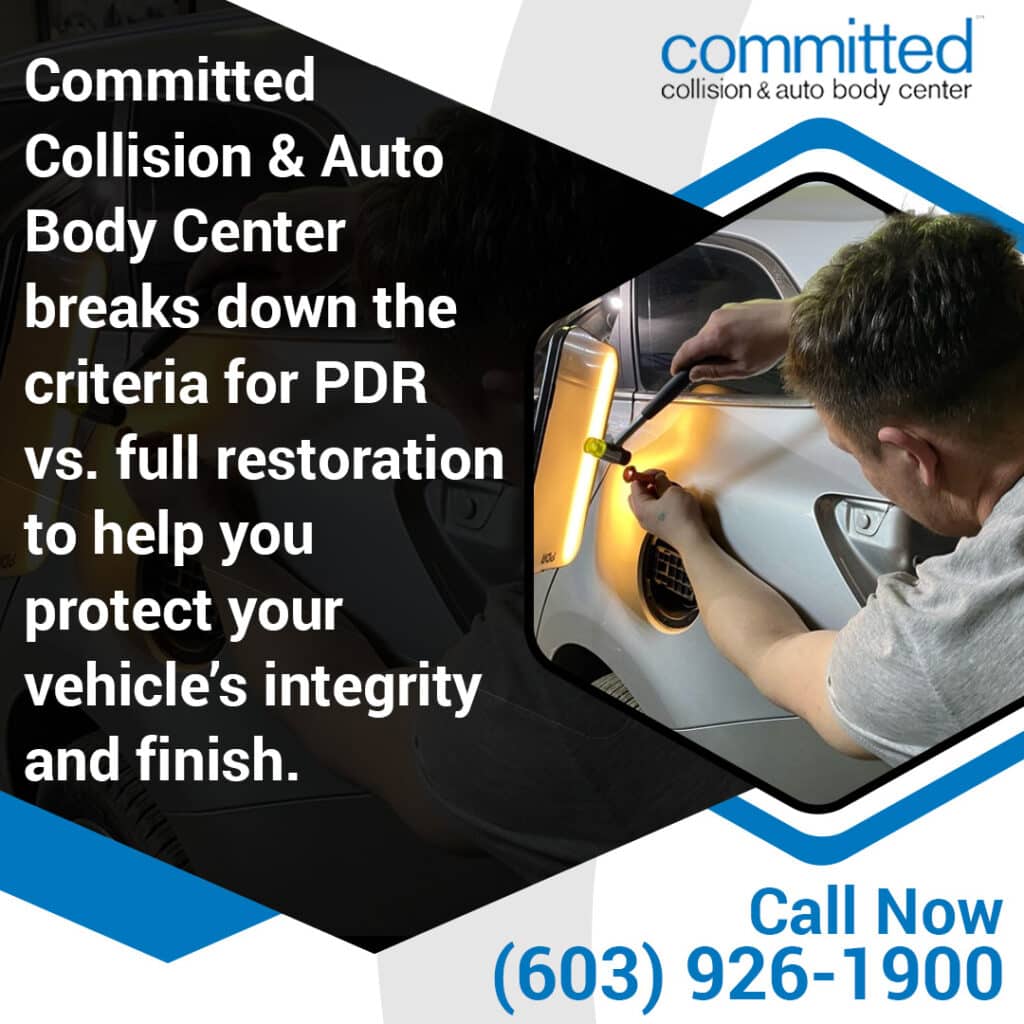
What Is the Difference Between PDR and Auto Body Repair?
What Paintless Dent Repair (PDR) Does
PDR removes dents by reshaping metal from behind the panel without disturbing the paint.
Our technicians use the Keco PDR and Glue Pull Station to massage the dented area back into place; no sanding, no filler, no repainting. The factory finish stays intact, and with no curing time needed, many PDR repairs finish the same day.
PDR works best for:
- Door dings with undamaged paint
- Minor creases with the surface coating fully intact
- Hail impacts on flat panels like hoods, roofs, and doors
What Professional Auto Body Repair Involves
Professional auto body repair handles what PDR cannot: cracked paint, stretched metal, and damage beneath the surface.
Our process covers panel reshaping or replacement, body filler, sanding, priming, and repainting through our USI Spray Booths with Glasurit 100 Line waterborne paint. We also perform frame straightening and structural repair using the Chief 3D Laser Measuring System to bring your vehicle back to factory specifications. When paint is broken or metal is beyond recovery, this is the right path to a safe, lasting result.
7 Signs Your Dent Needs Auto Body Repair Instead of PDR
Getting the repair method wrong or skipping proper repair entirely leads to larger problems later. These seven signs point to auto body repair over PDR.
1. Paint Is Cracked, Chipped, or Missing
PDR cannot address paint failure. A compromised surface needs refinishing before corrosion takes hold.
On the NH Seacoast, road salt and coastal moisture get into any break in the paint fast. What looks like a minor surface dent today can develop into a rust problem inside one winter if the paint is not restored.
2. The Dent Has Sharp Edges or Deep Creases
Deeply creased or stretched metal loses its ability to return to shape on its own.
PDR depends on the natural memory of the metal. A sharp crease or stretch beyond the panel’s tolerance means filler and refinishing are required to restore a smooth, even surface. Pushing PDR on this type of damage typically causes paint failure within a short time.
3. The Dent Is on a Panel Edge or Body Line
Panel edges and character lines are structurally reinforced. They are harder to reach from behind and require more controlled repair techniques. Damage along these areas generally calls for bodywork and blending to achieve a clean, lasting result.
4. Damage Spans Multiple Panels
When impact has spread across more than one panel, the force involved was considerable. Damage at this scale typically extends below the surface, and a full repair process, not a spot treatment, is what’s needed.
5. Aluminum Panels Are Involved
Aluminum does not behave like steel under impact. It is more prone to tearing, does not hold shape the same way, and demands a distinct repair approach. Our technicians are trained in aluminum-specific techniques that include heat treatment, panel realignment, welding, and refinishing. We also use dedicated equipment for aluminum work, including the Pro Spot PR-5D and our aluminum rivet tooling.
6. There Are Signs of Hidden Damage
Modern vehicles carry sensors, structural brackets, mounting hardware, and safety components behind their body panels. A dent that appears entirely cosmetic from the outside can involve damage underneath that only disassembly will reveal. The full extent of what happened to a vehicle cannot be known until those panels come off.
7. A Sensor Location Was Near the Impact
Even a modest hit near a camera or radar unit can shift its alignment enough to affect performance. Industry data shows that only around 8% of collision repair shops nationwide complete proper post-repair calibrations, which means most vehicles with sensor-adjacent damage leave without a full systems check. If an ADAS component was near the impact zone, those systems need to be verified after repairs are done. Post-repair ADAS calibrations are handled by our sister company in North Hampton, Automotive Alignments & Calibrations LLC (AAC).
When Paintless Dent Repair Is the Right Choice
PDR is an excellent tool when the conditions support it. Industry data indicates that roughly 80% to 90% of typical dents are suitable for paintless dent repair (PDR), provided the factory paint remains uncracked, and the metal has not been severely stretched or creased.
Ideal Conditions for PDR
- The paint is completely intact; no chips, cracks, or missing coating
- The dent is shallow, smooth, and the panel can be accessed from behind
- The metal has not been stretched or sharply creased
Common Scenarios Where PDR Is a Good Fit
- Single door dings from the parking lot contact
- Small bumper impressions where paint is untouched
- Multiple shallow hail impacts across flat body panels
Why PDR Preserves More Than Just Appearance
| Benefit | Why It Matters |
| Factory paint stays intact | Original finish supports vehicle resale value |
| No color matching needed | No risk of panel inconsistency post-repair |
| No filler, primer, or paint materials | Generally faster and lower in cost |
| Same-day completion is common | Less time without your vehicle |
For PDR work, we use the Keco PDR and Glue Pull Station, a specialized tool that allows our technicians to access dents from behind the panel with controlled precision. During your inspection, we assess whether PDR is the right fit or whether a different approach is needed.
Why the Wrong Repair Choice Costs You Later
Applying PDR to damage that calls for traditional body work creates problems that surface later. Paint cracks over stretched metal. Uneven surfaces become more visible as the repair ages. Untreated paint damage allows moisture in, and corrosion follows, turning a manageable repair into a much larger one.
There is also a resale impact. CARFAX estimates that vehicles with reported damage history average roughly $500 less in retail value, while severe reported damage reduces wholesale values by nearly $2,100. The table below puts both repair outcomes in context:
| Scenario | Likely Result |
| PDR applied correctly; shallow dent, intact paint | Factory finish preserved; resale value typically maintained vs. repainted repairs. |
| PDR applied to creased or stretched metal | Elevated risk of paint cracking or clear-coat failure; may require conventional repair. |
| Vehicle with reported damage history (average) | ~$500 less in retail value (CARFAX, 2024). |
| Vehicle with a severe reported damage history | ~$2,100 less in retail value (CARFAX, 2024) |
A correct repair, done once, is what protects value and safety over the long term.
How We Assess Dent Damage at Committed Collision & Auto Body Center
At our auto body shop in North Hampton, NH, we follow a structured inspection process to determine whether PDR or full repair is required. Our process is methodical and in a specific order; not a quick estimate followed by assumptions.
Step 1: Visual Inspection at Your Appointment
We examine the dent’s location, depth, and paint condition during your scheduled visit. Visible damage is documented, and we share our professional opinion on any hidden concerns that may exist beneath the surface. You receive a quote based on what the inspection reveals.
Step 2: Repair Authorization and Drop-Off
Once you have reviewed the estimate and decided to move forward, we will schedule your drop-off date. Diagnostics and disassembly only start after your vehicle arrives at our shop and the repair has been authorized. OEM repair procedures guide the work from that point forward.
Step 3: Pre-Wash, Scanning, and Disassembly
With your vehicle in our shop, we wash the exterior to bring all surface damage into view. We then use an OBD-II scanner to read the vehicle’s computer for any stored fault codes. Disassembly follows — removing body panels reveals hidden structural damage, sensor bracket issues, and anything the outside inspection could not show. This is where the complete damage picture comes together.
Step 4: Repair Plan and Recommendation
With the full scope of damage confirmed, we put together a detailed repair plan. If PDR fits the damage, we use it. If the job calls for full structural repair or refinishing, we handle that and walk you through every step.
Our shop handles both approaches with purpose-built equipment: the Keco PDR and Glue Pull Station for paintless work, the Chief 3D Laser Measuring System and Spanesi Multibench pull stations for structural and frame repair, and USI Spray Booths with Glasurit 100 Line waterborne paint, used by over 80% of OEM manufacturers for refinishing.
How NH Seacoast Conditions Factor Into the Decision
The regional environment around North Hampton directly shapes how we think about dent repair. Winter road salt penetrates any break in the paint faster here than in drier inland climates. Seasonal temperature swings affect paint curing and how metal behaves during repair. Proximity to the coast adds year-round humidity exposure to any panel that is not fully sealed.
All of this means that treating paint damage as a cosmetic afterthought carries real risk in this region. A small chip or crack that might wait for attention elsewhere can become a corrosion problem here inside a single winter.
Can PDR and Auto Body Repair Work Together?
Yes, and in some situations, combining the two delivers the best outcome.
When damage is moderate, and the paint is only partially affected, we may use PDR to reshape the metal first, then follow with targeted refinishing. This reduces the amount of panel work needed while still producing a clean, durable surface.
There is no standard formula for every vehicle. Each recommendation comes from what the damage actually shows us, which is why inspection always comes before a repair decision, not after.
What to Look for When Choosing a Shop for Dent Damage
Not every auto body repair shop handles both PDR and full-scale body work. Here is what separates a capable shop from one that will refer you elsewhere the moment the damage is more complex:
- Certifications: I-CAR Gold Class and ASE credentials mean technicians meet current industry training standards.
- In-house capability: The ability to do PDR, structural repair, aluminum work, and refinishing under one roof avoids delays and miscommunication between shops.
- Disassembly before the final estimate: Any shop that writes a complete repair estimate purely from a visual inspection is guessing. Proper blueprinting happens after drop-off.
- OEM standards: Manufacturer repair procedures should be the default, not the exception.
As local auto body repair specialists serving the NH Seacoast, we hold all of the above and back every repair with a limited lifetime warranty covering workmanship, paint, and part performance.
Frequently Asked Questions
Can a dent be repaired without repainting the panel?
Yes, if the paint is intact and the dent is shallow, paintless dent repair can restore the panel without repainting.
How do I know if my dent has hidden damage?
If the dent involves deep impact, sharp creases, or is near sensors, hidden structural or system damage may exist and require inspection.
Is it safe to delay dent repair?
Delaying repair can lead to corrosion, paint failure, and reduced vehicle value, especially in coastal and winter conditions like North Hampton, NH.
Should I get my dent inspected before choosing a repair method?
Yes, a proper inspection is the only way to determine whether your dent needs PDR or full repair. A professional evaluation identifies hidden damage and helps prevent incorrect repairs that affect safety and long-term performance.
Make the Right Repair Choice with Committed Collision & Auto Body Center
For a shallow dent, with fully intact paint, PDR is likely the right call. In case of cracked paint, stretched metal, or significant impact, auto body repair is the correct path.
Getting this right the first time protects your vehicle’s safety systems, structural integrity, and long-term value. The wrong repair method or delaying the repair tends to cost more to undo later.
We start every evaluation with a thorough inspection, not a fast guess. Whether your vehicle needs a same-day PDR fix or more involved body work, our I-CAR Gold Class certified team at Committed Collision & Auto Body Center is equipped to handle it correctly from the first look to the final delivery.
Call us at (603) 926-1900 or email info@committedcollision.com for auto body repair in North Hampton, NH. We’re here to get your vehicle back to the condition it deserves.