
Synopsis
Vehicles in North Hampton face rust from two directions: road salt and coastal air. June is when that damage becomes more visible, and the repair scope is still contained. Committed Collision & Auto Body Center outlines where rust starts, what the three damage stages mean, when it becomes a safety issue, and what rust repair at our auto body shop involves.
Vehicles on the NH Seacoast face rust from two sources simultaneously: road salt from winter de-icing and salt-laden coastal air year-round, placing them among the most corrosion-exposed vehicles in the country.
Road salt corrosion works like this. Sodium chloride mixes with moisture on metal surfaces and forms an electrolyte solution. That solution accelerates oxidation on any exposed metal. After a New Hampshire winter, most Seacoast vehicles carry some degree of that damage, and most of it stays hidden until spring.
Surface rust addressed now stays manageable. Left through a humid coastal summer, it moves into structural metal. Committed Collision & Auto Body Center covers where rust begins on a vehicle, what the three stages mean, when it becomes a safety concern, and how our auto body repair in North Hampton, NH, deals with rust.
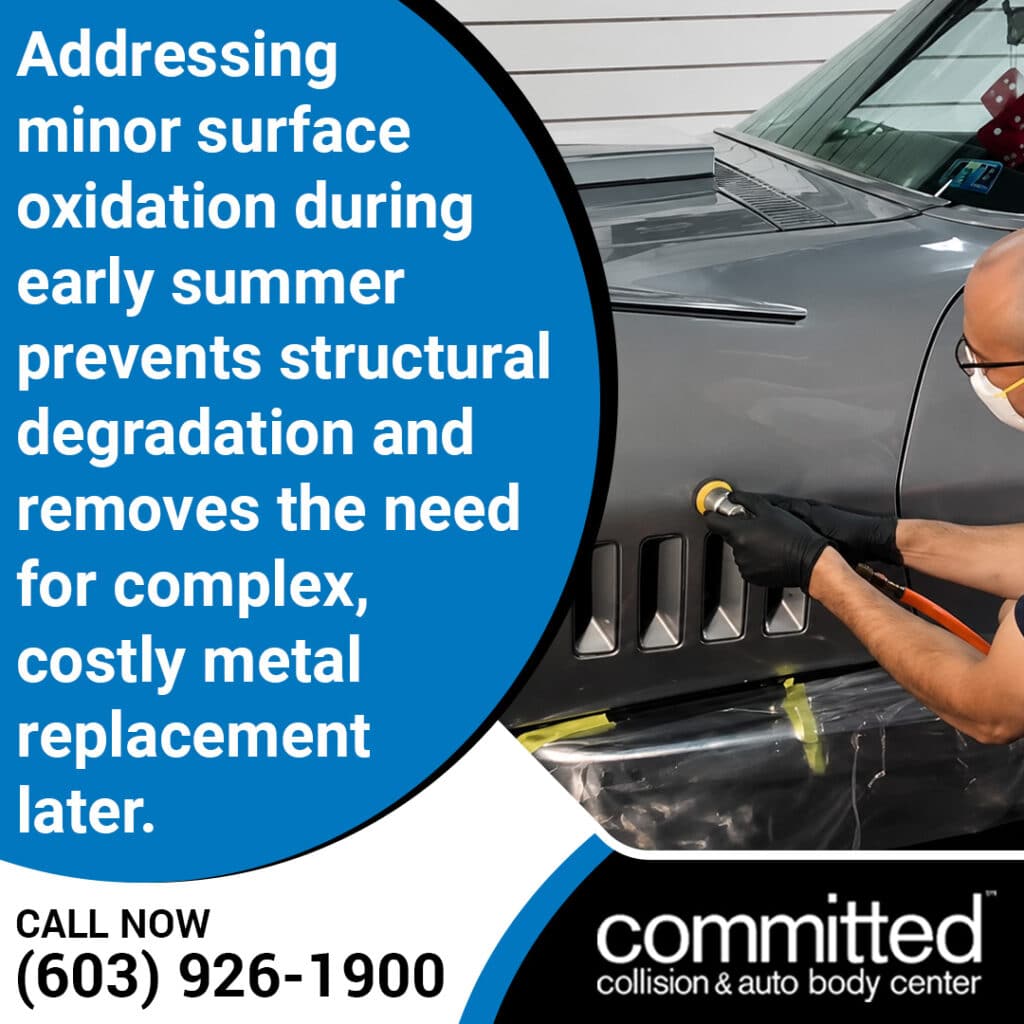
Why Do NH Seacoast Vehicles Face a Higher Rust Risk?
North Hampton vehicles face road salt from winter de-icing and salt air from the coast year-round. Most inland states deal with one of those factors. Here, both act on a vehicle at the same time, through every season.
New Hampshire applies approximately 400,000 tons of road salt annually, according to the NH Department of Environmental Services (NHDES). Every vehicle driven on NH roads through winter accumulates salt on its undercarriage, rocker panels, and wheel wells.
The financial impact is real. According to 2027 reports quoting the AAA, salt and de-icing chemicals cost U.S. drivers approximately $3 billion in rust-related repairs each year. The national average for a single rust repair is about $490. Most standard auto insurance policies consider corrosion to be normal wear and tear and generally do not cover rust damage. Coverage may differ depending on the policy and the specific cause of the damage.
That makes auto body repair in North Hampton, NH, a year-round concern, not only a post-accident one. June is the right window to act. Winter damage is now visible, and summer heat and humidity have not yet had time to drive it deeper.
Where Does Rust Start on a Vehicle?
Rust begins where a vehicle’s paint or protective coating has been broken down, leaving bare metal exposed to moisture. On a Seacoast vehicle, that happens in predictable places; mostly low, road-facing, and out of plain sight from a standing position.
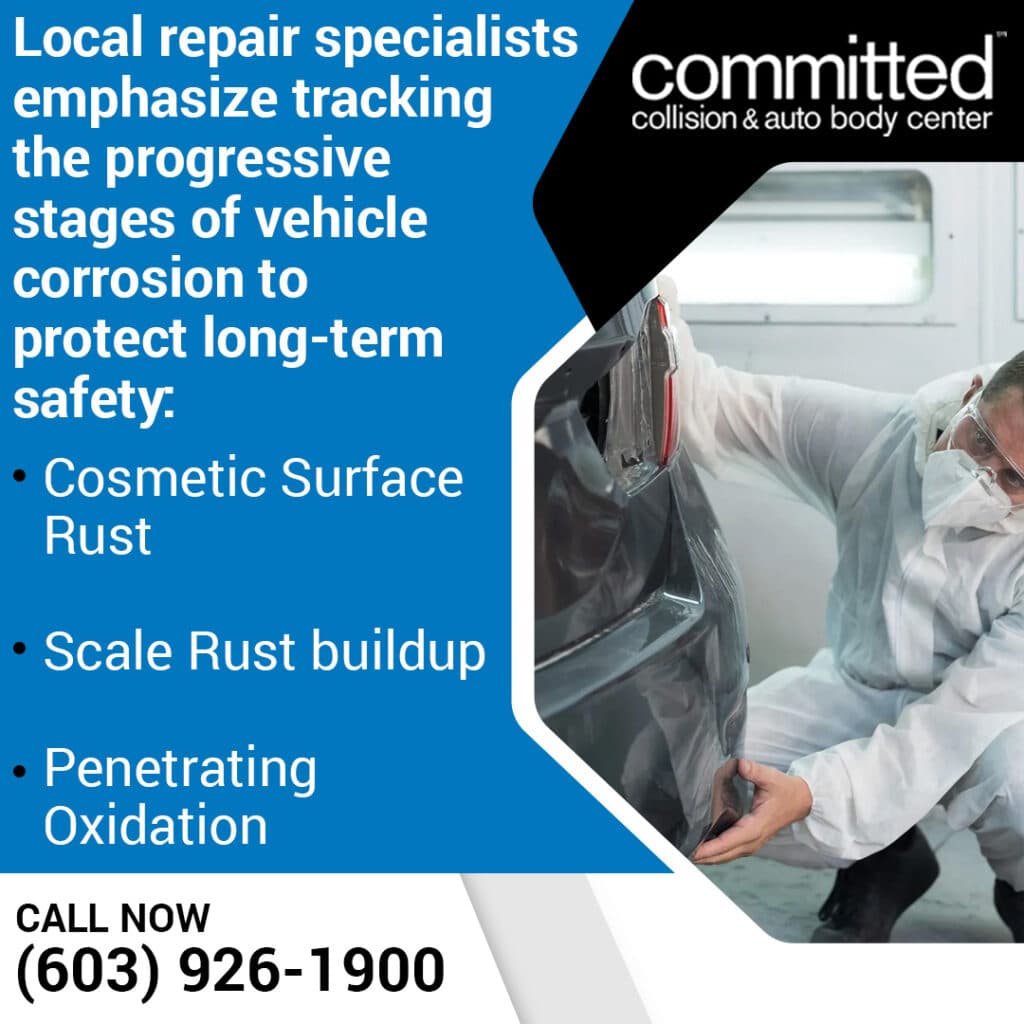
Three stages define how far corrosion has progressed. Surface rust is discoloration only. The underlying metal is still intact. Scale rust means the coating has broken through, and the metal surface is beginning to pit. Penetrating rust has worked through the full metal thickness and compromised structural integrity. The stage determines both urgency and repair type.
Rocker Panels and Undercarriage
Rocker panels run along the lowest section of the vehicle body between the front and rear wheel wells. They come into direct contact with road salt spray, stones, and road debris every winter drive. This is the most frequent rust origin on New England vehicles, a pattern our team sees season after season. The undercarriage is equally at risk and rarely assessed without a lift.
Wheel Wells and Fender Edges
Salt-saturated snow packs into wheel wells after winter drives. Even after roads dry, trapped moisture continues working against the metal inside. Fender edges are also vulnerable. Stone chips that remove paint leave bare metal exposed to every rain and salt event that follows.
Bumper Covers and Panel Edges
Road debris through winter creates small paint chips and impact marks on bumper covers and lower panel edges. Any bare metal that results begins oxidizing quickly. Minor collision damage that was not repaired before winter often surfaces as rust by June.
Structural Frame and Floor Pan
This is the most consequential rust location, and the least visible. Rust reaching the structural frame can alter the vehicle’s crash protection geometry. It cannot be detected in a walk-around. A lift inspection is the only reliable way to assess it.
When Does Rust Become a Safety Issue?
Surface rust is a cosmetic issue. Scale rust is a structural warning. Penetrating rust is a safety problem. The stage tells you how urgent the repair is and what it will involve.
- Surface rust: Orange or brown discoloration near panel edges. The metal beneath is still intact. Targeted repair and refinishing at this stage is well within normal scope.
- Scale rust: The coating has broken through. Pitting is visible on the metal surface. Panel strength is reduced. Repair is more involved but still a contained job.
- Penetrating rust: Corrosion has gone through the metal entirely. Structural integrity is compromised. Metal replacement is the only effective repair — surface treatment will not hold at this stage.
According to AAA, rust can weaken structural components, brake lines, and suspension systems. Because corrosion is classified as wear and tear, it is not covered by standard auto insurance, making early detection the most cost-effective approach.
According to AAA, drivers should seek prompt vehicle inspection if they notice any of the following warning signs:
- Dashboard warning lights related to the brakes or other essential vehicle systems
- A soft or spongy brake pedal when braking
- Excessive exhaust noise or exhaust fumes around the vehicle
- A noticeable gasoline or diesel odor while the vehicle is parked or operating
If any of these apply to your vehicle, schedule an inspection promptly. Rust that has reached brake lines or suspension components affects how your vehicle handles and how well it protects you. It should not wait. Addressing it now also protects the vehicle’s long-term resale value. Professional auto body repair addresses rust at the structural level, not just the surface, so your vehicle is safe before you drive it again.
What Does Rust Repair at an Auto Body Shop Actually Involve?
Initial Inspection and Estimate
We start with a visual walk-around: panels, bumpers, rocker panels, wheel wells, and the undercarriage where accessible. Every visible area of concern is documented, and we give you an initial estimate. Where rust may be deeper than the surface reveals, we flag that and discuss it with you before any repair work begins. At a qualified auto body repair shop, this assessment identifies the rust stage for each affected area and determines whether targeted metal repair or a full factory panel replacement is the right path.
Rust Removal and Metal Repair
At Committed Collision & Auto Body Center, rust repair means removing the damaged section entirely, not patching over it. We excise the corroded metal and weld in new galvanized steel. Galvanized steel has a zinc coating bonded to its surface that actively resists future corrosion in ways that bare replacement metal cannot.
When a complete factory panel replacement is available, it is the most reliable long-term outcome. We recommend it wherever that option exists.
Body filler alone is not a lasting solution in a coastal New England climate. It traps moisture beneath the surface. The rust resumes working from the inside out. Filler-only patches on rocker panels or undercarriage sections rarely hold through more than one or two winters here.
Structural Measurement Where Rust Has Gone Deep
When corrosion has reached frame components, we use the Chief 3D Laser Measuring System and Spanesi Touch Measuring System to verify that frame geometry still meets factory specifications. This is the same equipment used for collision-related structural repairs, confirming that corrosion has not altered the geometry that protects occupants before the repair is finalized.
Paint and Refinishing
After metal repair, the area is sanded, cleaned, and primed. We apply a corrosion-inhibiting primer over any bare metal before the base coat color goes on, matched to your vehicle’s original factory paint. A clear coat follows for UV protection and durability. The finished repair is cured in one of our three USI Spray Booths under controlled temperature.
We use Glasurit 100 Line waterborne paint, used by over 80% of OEM manufacturers, for accurate color matching across the repaired panels.
How to Check Your Vehicle for Rust Before Summer
A five-minute walk-around can tell you whether your vehicle needs a rust assessment before the summer season. You do not need a lift or tools, just good lighting and a few minutes.
Work around the lower half of the vehicle. Crouch down at each corner and look at the rocker panels, wheel wells, door bottoms, and bumper edges. These are the areas with the most road salt contact and the least routine cleaning.
Watch for these signs:
- Paint bubbling or lifting without any visible impact nearby. Rust forming beneath the surface pushes paint outward before breaking through
- Orange or brown discoloration along panel edges, door bottoms, or beneath trim pieces
- Bare metal visible where paint has chipped, cracked, or peeled away
- A soft spot or noticeable flex when you press firmly on a lower door edge or rocker panel
- Visible pitting or rough texture on any metal surface along the lower body
Undercarriage rust is rarely visible from a standing position. A vehicle can look clean from the outside and have significant corrosion underneath. Bringing your vehicle to our auto body shop in North Hampton, NH, for a free estimate gives you a professional assessment of what it actually needs based on what we find, not just what is visible on the surface.
Why Regional Experience Matters When Choosing an Auto Body Shop for Rust Repair
Corrosion patterns on NH Seacoast vehicles differ from rust in drier, inland climates. Road salt and coastal air create a year-round corrosion load that concentrates in specific areas: the undercarriage, rocker panels, and lower fender edges. Shops without a regional context focus on visible damage without accounting for where it is most likely hiding.
We have been repairing vehicles in North Hampton and the surrounding Seacoast communities since 2005. At Committed Collision & Auto Body Center, over 20 years of working on local vehicles means we know which panels rust fastest here, how quickly surface rust progresses in this climate, and what a thorough post-winter inspection needs to cover.
Our technicians hold I-CAR Gold Class and ASE certifications and receive continuous training. We prioritize OEM parts across all repairs. For rust that has penetrated structural components, our Chief 3D Laser Measuring System and Spanesi Touch Measuring System confirm that frame geometry is within factory specifications before any repair is finalized.
Choosing local auto body repair specialists with deep regional experience means getting the areas that matter most inspected accurately and repairs done right the first time. You will find numerous customer reviews online that show our commitment to quality. Here is a Google review from Cameron S.: “Committed Collision takes the stress out of taking care of your car. Derek and team have done a great job with both mechanic and body work for my car. Pleasant and timely communication and fair pricing. Can’t recommend them enough.”
Frequently Asked Questions
Is rust damage covered by auto insurance in New Hampshire?
Generally, no. According to AAA, corrosion is classified as normal wear and tear and is typically excluded from standard auto insurance coverage. Rust damage is the vehicle owner’s responsibility regardless of cause.
Can surface rust be repaired without replacing the full panel?
Yes, when caught at the surface or scale stage. We remove the corroded section and weld in new galvanized steel, then refinish the area. A complete factory panel replacement is the stronger option when penetrating rust has spread across the panel.
Does Committed Collision & Auto Body Center offer a warranty on rust repairs?
It depends on the repair method. Because rust can spread in ways that are difficult to predict, we do not offer a warranty on rust repairs unless a complete factory panel replacement is performed. We are upfront about this before any work begins, so you know exactly what is and is not covered.
How long does a rust repair take?
The timeline depends on where the rust is and how far it has progressed. A targeted repair on a single panel may take a few days. Repairs that involve structural metal or a full factory panel replacement take longer. We give you a specific timeline once we have assessed the full extent of the damage and completed the repair plan.
Worried About Rust? Get a Free Auto Body Repair Estimate This June
Road salt and coastal air make rust a year-round concern for NH Seacoast vehicles. June is the point in that cycle when winter damage is visible, and the repair scope is still contained. Surface rust caught now is a straightforward repair. Left through summer, it becomes a structural one.
If your vehicle showed any rust signs this spring: bubbling paint, staining near panel edges, or anything that did not look right, bring it in before summer humidity accelerates the damage.
Contact Committed Collision & Auto Body Center at (603) 926-1900 or info@committedcollision.com for a free estimate. We will assess your vehicle, explain exactly what we find, and give you a clear picture of what the auto body repair looks like before you commit to anything.