
Synopsis
Most drivers assume their vehicle is fixed once it leaves the shop. But substandard auto collision repair leaves behind warning signs that are easy to miss and costly to ignore. Committed Collision & Auto Body Center in North Hampton, NH, helps you identify the real signs your repairs weren’t done right and what to do about it.
Poor auto collision repair often hides in plain sight; in uneven panel gaps, returning dashboard warnings, paint that fades unevenly, and handling changes drivers dismiss as normal. Some of these signs are cosmetic. Others compromise your vehicle’s structural integrity and safety systems in ways that only become clear in a second collision. CAPA’s November 2011 QualityWatch Report #1 found that nearly 90% (13 out of 15) of independently manufactured aftermarket replacement parts tested failed to conform to CAPA’s requirements for comparability to car company brand parts. Parts that don’t conform to factory specs are one of the most common reasons a repair fails after the vehicle leaves the shop.
Committed Collision & Auto Body Center provides quality collision repair. Our skilled technicians use advanced diagnostic tools and equipment for precise repairs. Substandard work can be structural, cosmetic, mechanical, or electronic. The car may look repaired. That does not mean it was repaired correctly.
Why Not Every Collision Repair Meets Factory Standards, and What That Means for Your Vehicle
Substandard repairs are not isolated incidents. They are an industry-wide issue. Some shops use non-certified aftermarket parts, skip diagnostic scanning, rush reassembly, or omit post-repair quality checks to move vehicles faster.
In our experience, the consequences are rarely visible at pickup. They surface weeks or months later as rust at a repaired seam, a door that stops sealing, or a warning light that returns after a few drives. The Insurance Institute for Highway Safety confirmed in February 2018 that structural parts must exactly replicate originals for a vehicle’s crash protection to perform as designed. Parts quality is not a minor variable. It determines whether a repair holds.
OEM vs. Non-Certified Aftermarket Parts: Key Differences
| Factor | OEM Parts | Non-Certified Aftermarket Parts |
| Fit to factory specifications | Exact match to manufacturer specifications | 13 out of 15 tested parts (87%) failed CAPA’s comparability requirements to OEM brand parts |
| Crash protection performance | Meets the manufacturer’s original crashworthiness design | Must replicate original parts exactly to preserve crashworthiness integrity |
| Paint adhesion and finish life | Engineered for factory coating systems (galvanization, heat treatment, weld patterns) | Surface variances (missing galvanization, different welds, no heat treatment) can reduce paint adhesion and longevity |
| Warranty eligibility | Supports manufacturer warranty | Cannot automatically void the entire warranty. Under the Magnuson-Moss Warranty Act, the dealer must prove the part directly caused the failure to deny coverage |
What Does a Poor Collision Repair Look Like?
Uneven Panel Gaps and Misaligned Body Panels
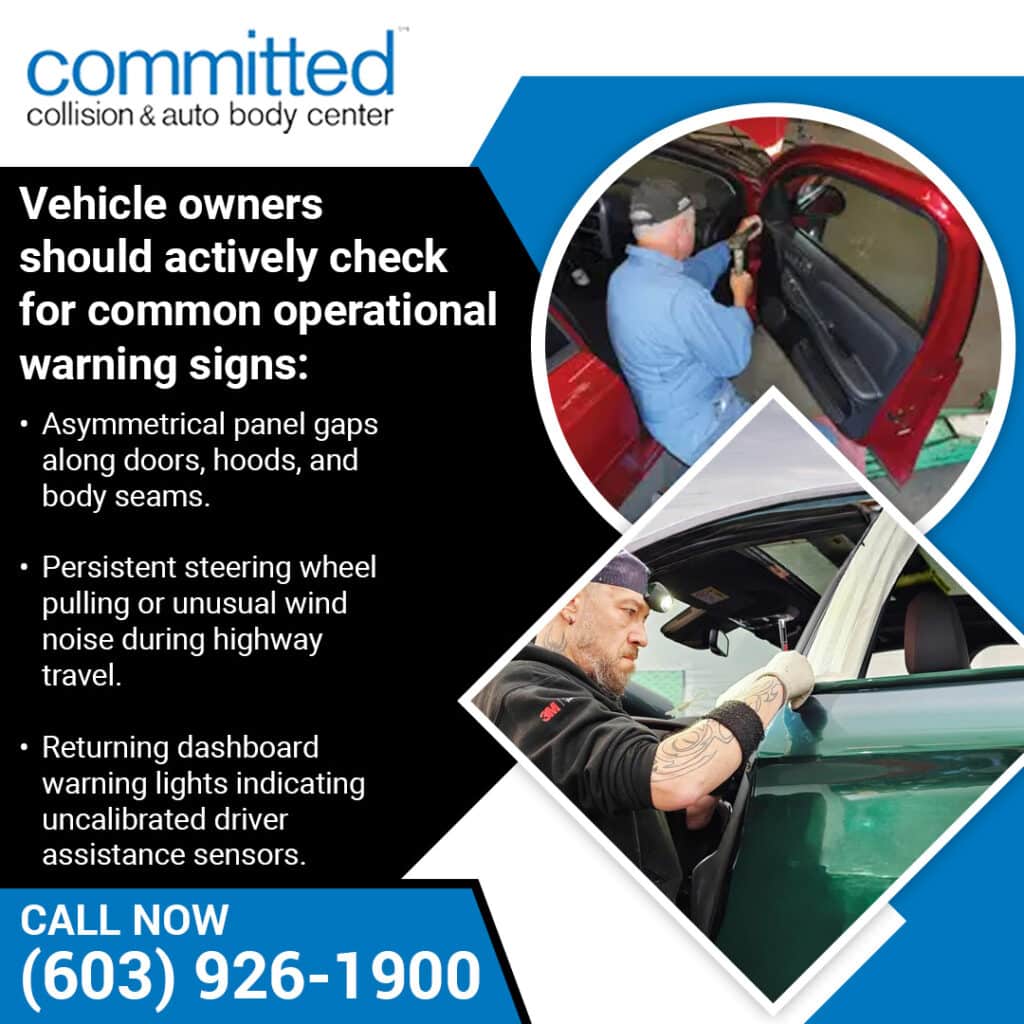
The clearest signs of a poor repair are visible without any tools. Check the gaps between your doors, hood, fenders, and trunk lid. In a properly repaired vehicle, those gaps are consistent and even. Gaps that vary in width, panels at different heights, or doors that won’t close cleanly signal improper reassembly or uncorrected frame damage. This is not cosmetic. It means the vehicle’s underlying geometry was not restored. We use the Chief 3D Laser Measuring System and Spanesi Touch Measuring System to verify frame geometry at every stage. When that step is skipped, the panels carry the evidence.
Paint That Doesn’t Match or Fades Unevenly
A proper refinishing job follows a defined sequence: surface preparation, primer, computerized color-matched base coat, clear coat, and a bake cycle to cure the finish. Signs of a rushed job include:
- Visible blending lines
- Orange-peel texture
- Color that reads differently in direct sunlight.
June on the NH Seacoast brings stronger UV exposure than winter, the season when many accidents happen. Panels that look noticeably different from the rest of the car by early summer signal an incomplete refinishing process. We use paint used by over 80% of OEM manufacturers, because correct paint selection is part of a proper repair.
Trim, Moldings, or Glass That Sits Incorrectly
Gaps around windows, loose trim, and rattling moldings all point to the same cause: parts not reinstalled to manufacturer specifications. Wind noise at a door frame that wasn’t there before the accident, water intrusion near a window, or a trim panel that used to be silent; each maps to a reassembly step left unfinished.
How a Bad Repair Affects the Way Your Vehicle Drives and Handles
Visual checks only tell part of the story. Some of the most telling signs of incomplete collision work appear behind the wheel.
Vehicle Pulls to One Side While Driving
Persistent pulling on a straight road after a repair points to uncorrected frame damage, improper structural repair, or suspension components that absorbed impact but were not addressed. Accurate structural repair requires measurement at multiple reference points before, during, and after straightening. Our shop works closely with Automotive Alignments & Calibrations LLC for wheel alignment and suspension assessment. Both are required for the vehicle to drive safely once repairs are complete.
Strange Noises: Rattles, Creaks, or Wind Noise
These sounds are widely dismissed as normal post-repair settling. They are not. Rattles point to unfastened components. Creaks suggest a weld didn’t hold or a structural area is flexing where it shouldn’t. Wind noise means a seal was missed during reassembly. None of these were present before the accident.
Dashboard Warning Lights That Reappear After Repair
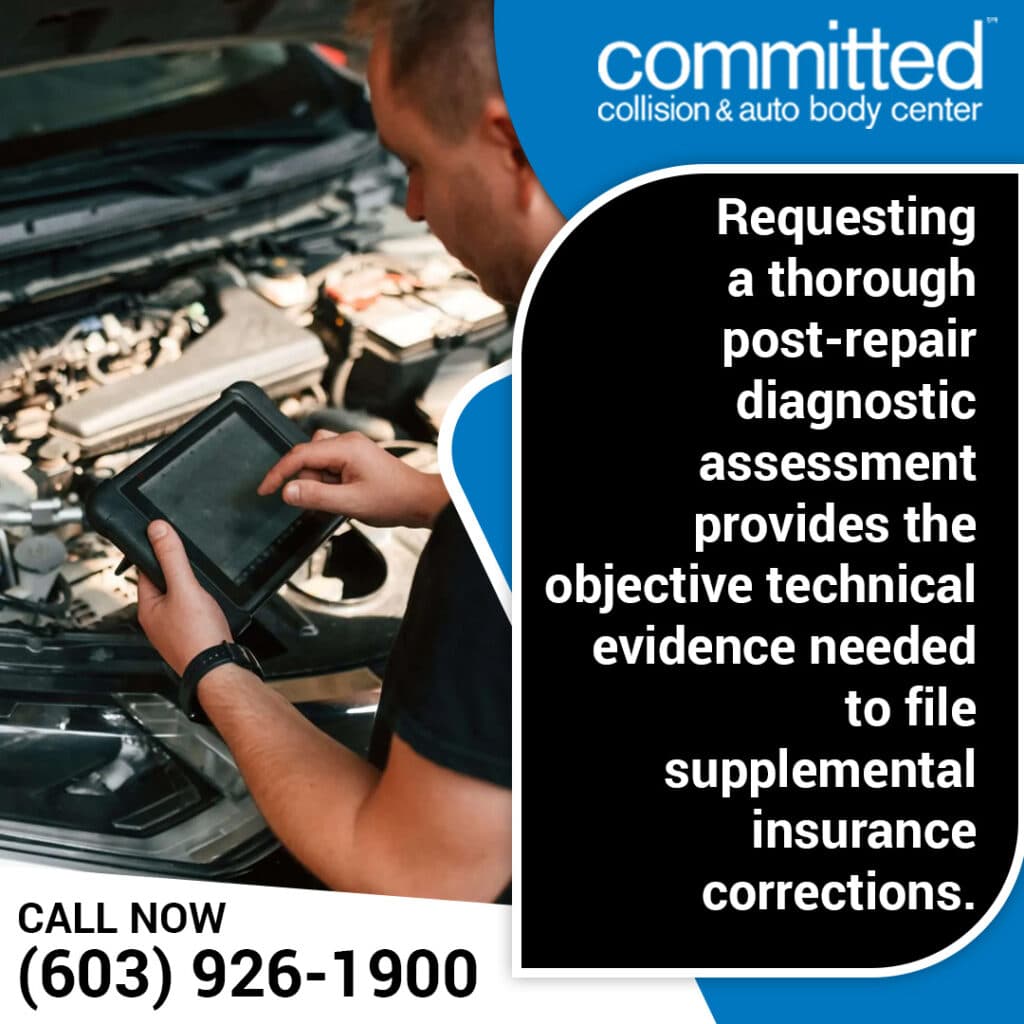
Warning lights returning after pickup are a direct sign of incomplete body collision repair: unresolved Diagnostic Trouble Codes (DTCs), missed sensor damage, or ADAS components that weren’t recalibrated. A proper repair includes pre- and post-repair OBD-II scanning to document and clear all codes. ADAS (cameras, radar, and sonar units powering lane assist, front crash mitigation, and parking functions) requires precise recalibration after any collision. Committed Collision & Auto Body Center works closely with Automotive Alignments & Calibrations LLC for post-repair ADAS recalibrations before your vehicle is returned.
Hidden Structural Damage and Early Rust: The Repair Failures Most Drivers Miss
A vehicle with unresolved structural damage may look repaired, but it may not perform safely in a second collision. These are the failures we find most often when inspecting vehicles with prior repairs, and the hardest for drivers to detect on their own.
Frame Damage That Wasn’t Fully Corrected
Uncorrected frame damage shows up as persistent pulling to one side, uneven tire wear, or handling instability that doesn’t respond to alignment adjustments. These are symptoms. The cause is that structural geometry never returned to factory specification. Structural components must exactly replicate the original geometry for crash protection to work as engineered. Proper frame straightening uses precision 3D laser measurement throughout. A repair that skips that step cannot confirm the vehicle is structurally sound.
Rust Starting to Form at Repaired Areas
Rust at a repaired seam or weld point within months of a repair signals inadequate surface preparation. This can be bare metal left exposed, primer not properly applied, or the area not sealed before painting. New Hampshire applies approximately 400,000 tons of road salt annually (NEIWPCC, 2025). That salt penetrates improperly sealed repairs through winter. By spring and early summer, the damage surfaces at exactly the spots where prep was skipped. Rust repairs carry a warranty only when a complete factory panel replacement is performed. What customers need is a free estimate, not a “free rust inspection.”
What Should You Do If You Suspect Your Collision Repair Was Done Incorrectly?
If your vehicle is showing any of these signs after leaving the shop, a second opinion from a qualified collision repair specialist can identify exactly what was missed. Incomplete auto collision repair is correctable, but only if you act on the evidence. Here is how we advise customers to approach it.
Start by documenting what you observe. Take dated photographs of panel gaps, paint inconsistencies, warning lights, and handling symptoms before returning to any shop.
Next, review your original repair order. A properly completed order includes itemized procedures, documentation of every part used, and pre- and post-repair scan results. Missing documentation is a warning sign in itself. Under the New Hampshire RSA 358-D:11 Section VII, motor vehicle repair shops must provide customers with an invoice for any service or repair work that itemizes all work performed, all parts supplied (valued over $0.50), and all labor charged.
Then request a post-repair inspection at a qualified car collision repair shop that follows OEM procedures. Ask whether the shop uses precision frame measurement and OBD-II scanning. Those tools reveal what a visual inspection alone cannot. If the repair was insured, document your findings and contact your insurer. Insurance companies are required to cover a proper repair.
What a Correctly Completed Collision Repair Includes: From Scanning to Road Test
Here is what a correctly completed repair covers, and what yours should have included. We begin with a pre-repair OBD-II scan to document all active Diagnostic Trouble Codes.
Disassembly follows after authorization, not during the initial estimate. So all hidden damage is found before the repair plan is written. Structural repairs use precision 3D laser measurement at every stage. Parts are OEM or verified alternatives, never sourced from unverified platforms. Paint refinishing covers the full sequence: surface preparation, primer, base coat, clear coat, and a bake cycle cure.
Reassembly follows factory torque specifications for every component. A post-repair OBD-II scan confirms all DTCs are resolved. We coordinate ADAS recalibration with Automotive Alignments & Calibrations LLC to verify every safety system before delivery. A road test checks steering, suspension response, and overall vehicle behavior before your keys are returned.
That is the standard every driver should expect from auto collision repair in North Hampton, NH. At Committed Collision & Auto Body Center, every vehicle goes through this complete process.
What Should You Look for in a Qualified Car Collision Repair Shop?
Three specific factors separate a qualified repair facility from one that cuts corners: certifications, parts practices, and warranty terms.
Certifications
Look for I-CAR Gold Class at the shop level. This requires ongoing training across the technical staff, not just one individual. ASE-certified technicians bring verified mechanical competence alongside body repair skills. Neither credential is a one-time designation.
Quality of Parts
Ask for a written repair plan that identifies every component before work begins. OEM parts should be prioritized across all collision and auto body repair work. No reputable shop sources parts from unverified platforms.
Warranty Terms
On warranty, coverage that applies to workmanship, paint, and part performance for the full duration of your ownership is the standard to expect. Short windows or exclusions on paint and structural work are worth questioning.
Committed Collision & Auto Body Center holds I-CAR Gold Class certification and employs ASE-certified technicians. Our repairs are backed by a limited lifetime warranty on workmanship, paint, and part performance, valid for as long as you own the vehicle. Here is what our customer, Jesus Labour C., said about us in a Google review: “They kept me updated every step of the way, making sure I understood exactly what was being done to my car. Communication was clear and consistent, which really gave me peace of mind throughout the process. When it was time to pick up my car, they walked me through every repair and explained the work in detail. What impressed me most was that they stand behind their work—it’s guaranteed for life. I left feeling confident and grateful for the care they put into both their work and their customer service.”
Frequently Asked Questions
How soon after a repair should warning signs appear if the work was done incorrectly?
Panel gaps, trim misalignment, and paint color mismatches are visible at pickup. Fading paint, wind noise, and dashboard warning lights typically surface within days to a few weeks. Rust at repaired seams takes longer, often months, though NH Seacoast vehicles exposed to road salt can show it sooner.
Can I return to the original shop if I find a problem after the repair?
Yes. Bring dated photographs and your original repair order, and request a re-inspection. You do not need a formal warranty document to do this; documented evidence of the problem is what matters. If the original shop is unresponsive, contact your insurer and schedule a free estimate at a qualified facility to get an independent assessment of what the repair requires.
Does insurance cover repairs that were done the first time incorrectly?
Coverage depends on your policy and insurer. We believe every insurance company is responsible for covering a proper repair, and we provide full documentation to support that position on your behalf. A supplemental claim for corrections is a recognized process; thorough records of photos, scan results, and repair orders strengthen your case.
Schedule a Free Estimate at Committed Collision & Auto Body Center
A vehicle that looks repaired and a vehicle that is repaired are not always the same thing. If your car is showing any of the signs above, our team is ready to take a look and give you a straight answer.
Contact Committed Collision & Auto Body Center is recommended by many of our customers as the best collision repair shop in North Hampton, NH. Contact us for a free estimate at (603) 926-1900, or info@committedcollision.com, or request your free estimate online.