
Synopsis
Learn what affects auto collision repair timelines in North Hampton, NH, including hidden structural damage, OEM parts availability, ADAS calibration, and insurance approvals. Committed Collision & Auto Body Center explains what drivers should expect from a professional collision repair process after an accident.
Collision repair timelines vary based on damage severity, hidden structural issues, parts availability, insurance approvals, and your vehicle’s technology. Minor cosmetic repairs move faster than structural ones, and modern vehicles with sensors, cameras, and driver assistance systems require more steps throughout the process. Repairs can take a few days to a few weeks, and sometimes longer, depending on what is found during disassembly. Knowing what drives the timeline helps you plan.
If your vehicle was recently damaged in an accident, Committed Collision & Auto Body Center explains what to realistically expect during our auto collision repair in North Hampton, NH. Knowing what drivers commonly need after an accident helps to avoid the stress of being caught off guard.
Why No Two Collision Repairs Take The Same Amount of Time
A collision repair estimate is never the full picture at first. Damage that looks minor on the surface often involves more than what is immediately visible. You cannot always tell what is underneath until a technician disassembles the vehicle.
Several factors shape how long repairs take. OEM (original equipment manufacturer) parts may need to be ordered from the manufacturer, and shipping timelines vary by make and model. Insurance adjusters may need to review estimates, approve specific parts, or authorize supplemental damage before work can continue. The vehicle itself also matters. Late-model vehicles with radar systems, aluminum panels, or high-strength steel require specific tools and OEM repair procedures that add time to execute correctly.
At Committed Collision & Auto Body Center, our collision repair specialists plan repairs carefully from the start. Our technicians document every step and communicate with your insurance provider so nothing gets missed and nothing surprises you later.
What Happens Before Repairs Begin
Initial Inspection and Vehicle Scanning
The process starts with a visual damage assessment, not full disassembly. We document visible damage and share a preliminary estimate. Once you authorize repairs and drop your vehicle off, we pre-wash the exterior to clear away dirt and debris, which reveals additional surface damage that may not have been obvious at first. We then run an OBD-II scanner to read diagnostic trouble codes (DTCs) stored in your vehicle’s computer, checking for any electronic issues triggered by the collision before disassembly begins.
With the pre-wash and scan complete, disassembly starts. Panels come off, structural components are measured, and a complete repair plan is written using OEM procedures. Timelines become more accurate at this stage and can change based on what we find.
Insurance Reviews and Repair Authorization
Insurance reviews happen before and during auto collision repair, especially when supplemental damage appears during disassembly. Initial approvals may cover visible damage only. Once disassembly reveals hidden issues, we submit supplemental documentation, including photos, part descriptions, and repair procedures, to support additional approvals.
Committed Collision & Auto Body Center communicates with your insurance provider throughout the process and keeps you informed of any changes. You can also request a free estimate online to get started.
The Most Common Reasons Collision Repairs Take Longer
Hidden Structural Damage
A bumper cover can conceal cracked impact absorbers, bent mounting brackets, and damaged frame rails. Suspension components, including control arms, tie rods, and wheel hubs, can absorb collision energy without outward signs. These issues only surface after disassembly, and they require additional inspections, measurements, and parts to address properly.
OEM Parts Availability
Late-model vehicles require manufacturer-specific parts that meet factory fit and performance standards. Generic aftermarket alternatives may not match correctly or meet safety specifications. We do not source parts from third-party discount platforms. Every part we order is traceable, quality-verified, and right for your specific vehicle. Some components must ship from the manufacturer, which adds to the timeline.
ADAS Calibration and Electronics
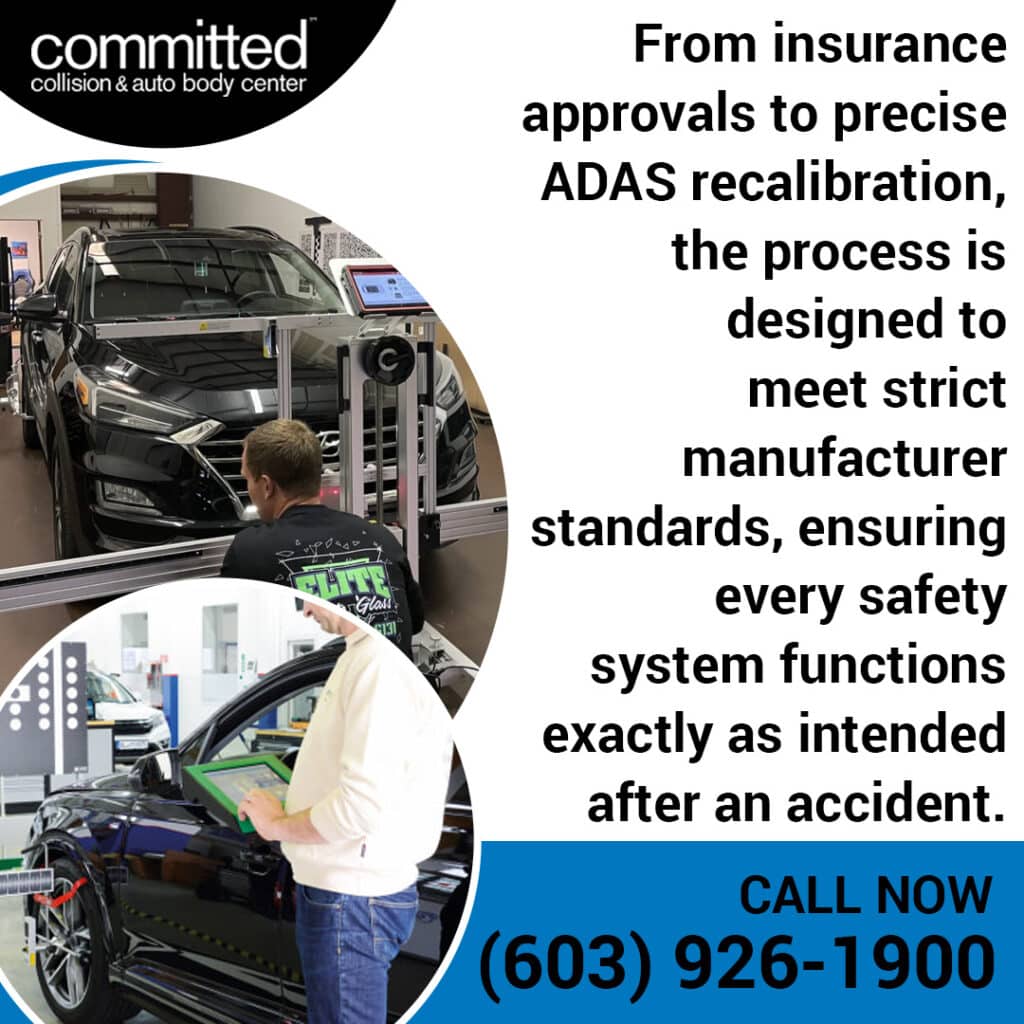
Advanced driver assistance systems, including lane departure warning, adaptive cruise control, forward collision warning, and automatic emergency braking, rely on precisely positioned cameras, radar, and sensors. A collision can shift these components even slightly, and even minor misalignment affects how they function.
According to the Highway Loss Data Institute, approximately 55% of registered U.S. vehicles are projected to have front crash prevention systems by 2028. As more vehicles carry this technology, post-repair ADAS calibration becomes a standard part of modern body collision repair, not an exception.
Many vehicle manufacturers require ADAS recalibration following repairs involving sensors, cameras, alignment changes, suspension work, windshield replacement, or collision-related structural repairs. Our sister company in North Hampton, Automotive Alignments & Calibrations LLC, handles this using Hunter/Bosch DAS 3000 calibration equipment.
Paint Matching and Refinishing Time
Refinishing involves more steps than most drivers realize. Panels are sanded, cleaned, and primed before color goes on in multiple thin coats. A clear coat follows, and once both layers are complete, the finish goes through a bake cycle, a controlled heat process that locks in the result.
In coastal New Hampshire, humidity affects drying times, making that controlled environment critical. We use a computerized paint-matching system that reads your vehicle’s original manufacturer paint code and applies Glasurit 100 Line waterborne paint, a premium refinishing system approved by numerous vehicle manufacturers for color accuracy and finish quality, across our three USI spray booths.
Typical Collision Repair Timelines by Damage Type
Every vehicle repaired at our car collision repair shop is handled case by case. The table below reflects a realistic repair scope, not fixed timeframes, since actual timelines depend on parts, insurance approvals, and what disassembly reveals at our car collision repair shop.
| Damage Type | Common Repair Areas | Factors That Affect Timeline |
| Minor cosmetic | Bumpers, surface dents, scratches | Paint curing, parts availability, and PDR suitability |
| Moderate collision | Multiple panels, suspension, sensors | Diagnostics, insurance approvals, part orders |
| Major structural | Frame, airbags, ADAS systems | Structural repairs, recalibration, and diagnostic scanning |
Front crash prevention in U.S.-registered vehicles by 2028: approximately 55%
(Source: Highway Loss Data Institute / NSC Injury Facts)
The average age of U.S. passenger cars and light trucks reached 12.6 years in 2024
(Source: S&P Global Mobility / Bureau of Transportation Statistics)
Minor Cosmetic Repairs
Small dents, surface scratches, and minor bumper damage may move faster when no structural issues exist beneath the surface. Paintless dent repair (PDR) with our Keco PDR and Glue Pull Station can reduce time further when conditions allow. Even so, we include an OBD-II scan to check whether the impact triggered any diagnostic trouble codes.
Moderate Collision Repairs
Multiple panel replacement, suspension inspections, and sensor replacement require additional diagnostics and part sourcing. Structural measurements are standard throughout the process. We use a Chief 3D Laser Measuring System to verify frame alignment at each stage. Insurance approvals for supplemental damage often extend this phase.
Major Structural Repairs
Airbag deployment, frame repair, and ADAS recalibration require verification at every stage before moving forward. When accident-related mechanical work is needed, Automotive Alignments & Calibrations LLC, our sister company, handles those repairs as part of the process. Committed Collision & Auto Body Center does not cut any steps to speed up delivery. A proper repair takes the time it takes.
Why Modern Vehicles Require More Repair Time
Today’s vehicles are built with high-strength steel, aluminum panels, and integrated electronics that change how repairs must be done. Factory OEM procedures specify exact methods for welding, part replacement, measuring, and calibration because these structures are designed to absorb crash energy in specific ways. Skipping those steps affects how the vehicle performs in a future collision.
According to S&P Global Mobility, sourcing Bureau of Transportation Statistics data, the average age of U.S. passenger cars and light trucks reached a record 12.6 years in 2024. Many of these vehicles carry ADAS technology, meaning calibration is now part of far more collision repair jobs than it was five years ago.
Our technicians receive yearly training to stay current with evolving vehicle systems, and we use the Pro Spot PR-5D for aluminum repair and factory scan tools for Hyundai, Kia, GM, Ford, Toyota, Mazda, and Nissan vehicles.
How Good Communication Improves the Repair Experience
Not knowing what is happening with your vehicle is one of the most common sources of stress after an accident. We keep you updated when timelines shift, when supplemental damage is found, or when parts are delayed. Working with a local collision repair shop in North Hampton means you can call or stop in and speak directly with the people working on your vehicle instead of a call center.
Every repair step is photographed and logged. This supports your insurance claim, confirms the work completed, and gives you a clear record if questions come up after pickup. When something changes, whether a part is backordered or disassembly reveals additional damage, we contact you directly to explain the situation and what it means for your timeline.
What to Look for in a Collision Repair Shop
Certifications, Standards, and Shop Capability
I-CAR Gold Class certification and ASE-certified technicians are baseline indicators of training quality. I-CAR requires ongoing education, not a one-time credential. Shops that follow OEM repair procedures work to the manufacturer’s standards at every step.
At Committed Collision & Auto Body Center, this applies to frame measurement with our Chief 3D Laser Measuring System, aluminum repair with the Pro Spot PR-5D, and post-repair ADAS recalibration handled by Automotive Alignments & Calibrations LLC. Professional collision repair today requires both the equipment and the training to address the full scope of modern vehicle complexity.
A collision repair specialist should be able to perform or coordinate ADAS calibration for late-model vehicles after an accident.
Transparency and Warranty
Written repair plans, itemized estimates, and photo documentation show that a shop is accountable. We document every repair step and work directly with your insurance provider throughout the process. We back our work with a limited lifetime warranty on workmanship, paint, and parts for as long as you own the vehicle.
This is the Google review left by our customer, Wolfgang H., for us: “Very happy with my experience with Committed. Was in a small accident that damaged the front of my RAV4. They got it looking like new. The whole process, everyone was very kind and patient in answering questions. They sent plenty of updates. Would refer people to them and use them again.”
What You Can Do to Help the Process Move Smoothly
A few actions on your end keep the repair process moving:
- Respond to insurance requests without delay
- Share accurate accident details
- Remove personal items from the vehicle before drop-off
- Stay reachable for supplemental repair authorizations
- Ask questions during the repair planning stage
The more information we have early in the process, the easier it becomes to anticipate hidden damage and parts requirements.
Collision Repairs Take Time for a Reason
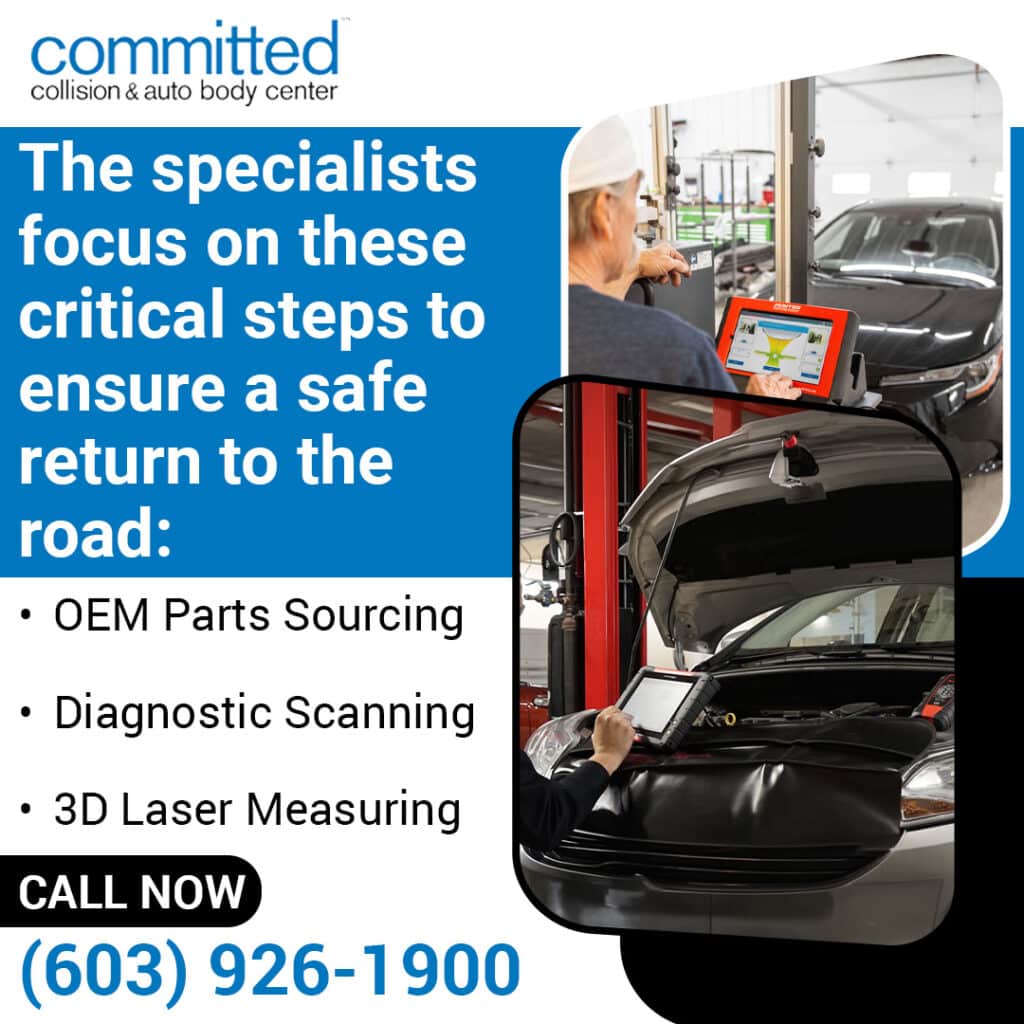
At Committed Collision & Auto Body Center, every repair follows a documented process: pre-wash, scanning, disassembly, OEM-spec repairs, refinishing, reassembly, calibration, and quality control before the keys come back to you. We do not cut steps. Every vehicle that leaves our collision repair shop in North Hampton, NH, has been inspected, tested, and verified.
Drivers searching for the best collision repair shop in North Hampton, NH, should look for documented repairs, OEM procedures, and trained technicians. If you have been in an accident, schedule a free estimate or call us at (603) 926-1900. You can also reach us at info@committedcollision.com. We serve drivers across the NH Seacoast and surrounding communities.