
Synopsis
A post-repair road test verifies that a repaired vehicle performs safely under real driving conditions before delivery. Committed Collision & Auto Body Center in North Hampton, NH, explains how diagnostics, steering checks, suspension testing, ADAS recalibration, and final inspections help confirm proper collision repair quality and long-term vehicle performance.
A post-repair road test is the final stage of the collision repair process; the step where every repaired system gets verified under real driving conditions before your vehicle is returned to you. At Committed Collision & Auto Body Center in North Hampton, NH, our quality control sequence covers diagnostics, structural measurement, function testing, and a full road test before we hand you your keys.
When you pick up your vehicle after a repair, you expect it to look right, but does it drive right? Today’s vehicles run on interconnected electronic systems, radar sensors, and precisely calibrated safety technology. A repair that restores the exterior without verifying what is underneath is not complete.
Auto collision repair done right goes well beyond bodywork. The post-repair road test is the stage in our collision repair process where we move from the shop floor to real driving conditions to check everything that diagnostics alone cannot tell us. As a collision repair specialist serving the NH Seacoast, we have seen firsthand what gets missed when this step is skipped. Here is exactly what that process covers.
What We Check Before the Road Test Begins
The road test is the final stage of quality control, not the only one. Before your vehicle reaches the road, our technicians work through a structured pre-drive sequence.
Post-Repair Diagnostic Scan
We begin with a full OBD-II scan using factory scan tools for Hyundai, Kia, GM, Ford, Toyota, Mazda, and Nissan vehicles. Our technicians, I-CAR Gold Class and ASE-certified, read the vehicle’s computer for stored Diagnostic Trouble Codes (DTCs), sensor communication faults, and any electronic errors that developed during the repair. Active fault codes get resolved before the vehicle advances. A repaired vehicle with open trouble codes is not ready for delivery.
Visual Inspection and Function Testing
Our technicians walk the vehicle and check panel gaps, fastener seating, trim placement, and tires before the test drive. We also test onboard systems for correct operation: headlights, tail lights, turn signals, backup camera, sensors, and the infotainment unit. A collision can loosen connectors throughout the vehicle, not just at the point of impact. Function testing catches those before the vehicle leaves the bay. Proper body collision repair also includes checking panel alignment, fastener fitment, and sealing surfaces before road testing begins.
Structural Measurement Verification
Where frame or structural repairs were performed, we verify geometry using our Chief 3D Laser Measuring System. Our Spanesi Multibench pull stations and Spanesi Touch Measuring System are used throughout structural work to pull and measure corrections precisely. Frame geometry that falls outside manufacturer tolerances can contribute to pulling, uneven tire wear, and added stress on suspension components over time. All structural measurements are signed off before road testing begins.
What Our Technicians Evaluate on the Road Test
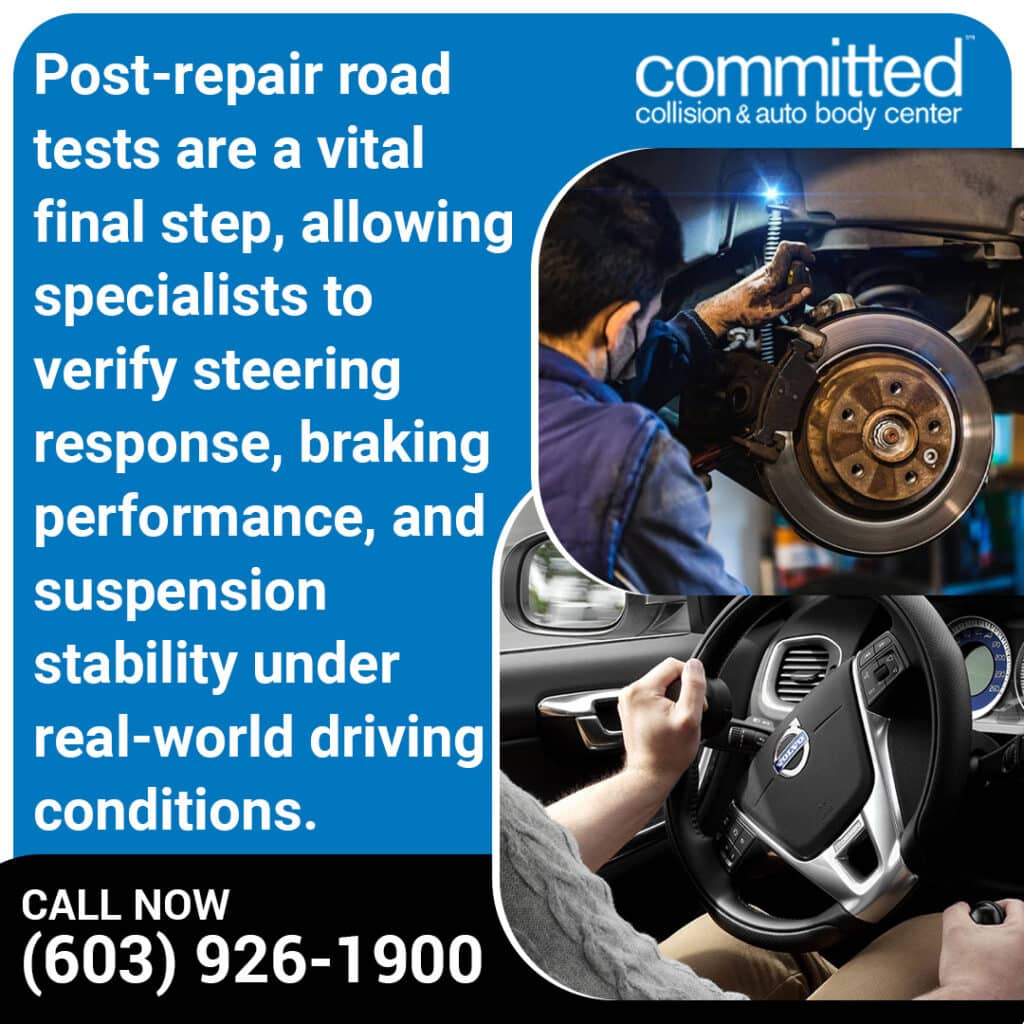
The road test is a structured, system-by-system drive. This is the phase of collision repair quality control that reveals what only motion can show. Our technicians follow a set sequence so nothing gets skipped.
Steering and Vehicle Tracking
The steering wheel should sit centered at straight-ahead, and the vehicle should hold its line without pulling. We evaluate responsiveness at low and moderate speeds. Steering and suspension testing is considered an important part of structural repair verification after collision damage. It tells us whether the geometry confirmed on the frame translates correctly to how the vehicle drives. At Committed Collision & Auto Body Center, any pull or tracking issue gets corrected before the vehicle is cleared.
Brake Performance
Pedal feel, firmness, and stopping distance are evaluated. Brake system operation and ABS functionality are verified following manufacturer-recommended testing procedures. Any noise, soft feel, or vibration through the pedal is flagged immediately. Where brake hardware needs attention, we coordinate with AAC, our sister company in North Hampton, before the vehicle is cleared for delivery.
Suspension and Ride Quality
The chassis transmits information during a drive that a static inspection cannot. We listen for clunks, squeaks, and vibration over road imperfections, check ride height symmetry side to side, and observe shock and strut behavior under load. Suspension components affected by a collision can go unnoticed until the vehicle is in motion – catching those is exactly what the road test is for.
Powertrain and Warning Lights
Idle quality, acceleration response, and transmission shift behavior are all observed during the drive. A collision can disturb wiring, sensor mounts, and connectors in the engine bay without leaving visible marks on the body. Any warning light or rough running that appears during the road test is flagged, and we work with AAC, our sister company in North Hampton, to address anything mechanical before the vehicle is cleared.
Panel Fit, Wind Noise, and Interior Trim
Poor panel fitment becomes audible at road speed. We check door seals, window seals, and trim alignment while driving to catch any wind intrusion that points to a panel that did not seat fully. Interior rattles from loosely placed clips or trim are also addressed here. These details are part of every auto body repair inspection we perform.
| Road Test Check | What We Look For | What It Tells Us |
| Steering & Tracking | Centering, pull, drift, response | Whether structural and alignment repairs meet factory spec |
| Brake Performance | Pedal feel, ABS response, noise | Whether braking systems are fully operational |
| Suspension & Ride | Clunks, vibration, ride height | Whether suspension components are seated and functioning |
| Powertrain Behavior | Idle, acceleration, warning lights | Whether any powertrain faults were introduced by the collision |
| Wind Noise & Trim | Seals, panel fitment, and interior rattles | Whether reassembly is complete and panels are properly seated |
| Post-Repair OBD-II Scan | Active codes, sensor faults | Whether all diagnostic trouble codes are fully resolved |
Why ADAS Recalibration Is a Required Step
A road test cannot substitute for proper ADAS calibration. These are two distinct steps; a vehicle safety inspection after accident repair requires both.
Advanced Driver Assistance Systems (ADAS): lane departure warning, adaptive cruise control, automatic emergency braking, blind spot monitoring, rear cross-traffic alert, parking sensors, front radar, LiDAR, and sonar, depend on sensors and cameras at precise manufacturer-specified angles. Frame straightening, suspension corrections, and bumper replacement can all shift those angles. A displaced sensor may not always trigger a warning light, yet it may no longer operate within manufacturer-specified parameters.
How We Handle Recalibration
We work closely with Automotive Alignments & Calibrations LLC (AAC), our sister company in North Hampton, for all post-repair recalibrations required after collision work.
AAC performs two types of calibration depending on what the vehicle manufacturer requires. Static calibration is done in a controlled shop environment using manufacturer-approved targets, covering Front Radar, LiDAR, Eyesight, Blind Spot Monitors, Cross Traffic Braking, and Parking Assist. Dynamic calibration is completed on a structured test drive, allowing the system to reset its sensor parameters under real driving conditions.
ADAS calibration procedures are performed using advanced Hunter/Bosch DAS 3000 calibration equipment and alignment systems while following applicable OEM repair procedures.
What Happens at Final Inspection and Pickup
When the road test and recalibration are complete, our technicians run a final visual inspection. A detailed final inspection remains one of the most important parts of our auto collision repair in North Hampton, NH, for structural or safety-related repairs. Every repaired component is checked for correct alignment, and every system is verified as functioning. A team member then contacts you to let you know your vehicle is ready.
When you arrive, we walk you through every repair that was performed. You are offered a test drive so you can feel the vehicle’s performance for yourself before the keys change hands. All road test outcomes are documented. If any issue arises during quality control, we will contact you before pickup. That communication is part of our process, not an exception to it.
Questions to Ask Any Shop Before You Drive Away
Before leaving any car collision repair shop with your repaired vehicle, ask these questions and request documentation:
- Was a post-repair OBD-II scan completed and all codes cleared?
- Was a structured road test performed and documented?
- Were ADAS systems recalibrated per the manufacturer’s procedures?
- Were OEM procedures followed for all structural work?
- Is there a written warranty on workmanship, paint, and part performance?
A shop that completes all of these steps will answer directly and back it up with documentation. Drivers searching for the best collision repair shop in North Hampton, NH, should ask about post-repair road testing, diagnostics, and ADAS calibration before approving repairs.
Customer reviews can provide additional insight into how a collision repair shop communicates, handles repairs, and supports customers after delivery.
Signs to Act on Immediately After Pickup
- A warning light was not present when you dropped the vehicle off
- Steering that pulls consistently to one side
- Vibration at highway speed was not present before the accident
- Wind or water intrusion around a repaired door, window, or seal
- An ADAS alert that triggers when it should not, or fails to trigger when it should
Do not wait on any of these. Call us right away. Our limited lifetime warranty on workmanship, paint, and part performance covers you, and we want to make it right immediately.
Why the Road Test Protects Your Vehicle Long-Term
The road test validates everything that came before it: structural repairs, scan results, alignment measurements, and reassembly. A vehicle that completes a thorough post-collision road test and requires ADAS recalibration is better positioned to perform according to manufacturer repair standards. Proper structural repairs help support vehicle safety performance in future driving conditions and potential collision events. ADAS systems that are off-spec may not perform when they matter most. Alignment issues left unresolved wear through tires and stress suspension components mile by mile.
A complete auto collision repair is measured by how every system performs over the months that follow, not just how the vehicle looks at pickup. That is the standard our collision repair quality control process is built around, from the first diagnostic scan to the final handover. We back qualifying repairs with a limited lifetime warranty on workmanship, paint, and part performance for as long as you own the vehicle. Terms and conditions apply.
Schedule a Collision Repair Inspection After an Accident
If you have been in an accident and need auto collision repair in North Hampton, NH, our team at Committed Collision & Auto Body Center is ready to walk you through every step, from initial inspection to final road test and delivery. No step gets skipped. Contact us at (603) 926-1900 or info@committedcollision.com. We are a family-owned shop serving the NH Seacoast since 2005, I-CAR Gold Class, and ASE certified.